Insights on India

Explore articles and updates related to India in the aviation and drone industry.

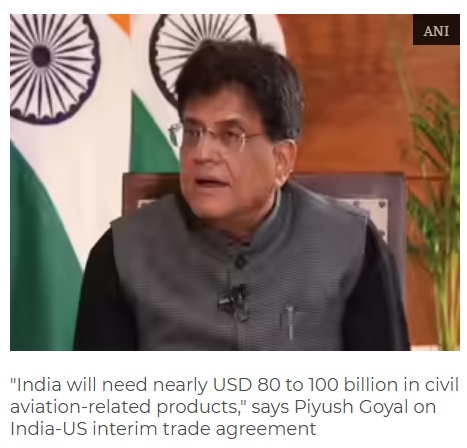
India will Need Nearly USD 80 to 100 Billion in Civil Aviation-Related Products.
Commercial Aviation Aviation

India will Need Nearly USD 80 to 100 Billion in Civil Aviation-Related Products.

Amid India's growing commercial needs in the aviation industry, the Union Commerce and Industry Minister estimated that India needs USD 80-100 billion in civil aviation products, underscoring the nation's development in the aviation market. Goyal said the India-US interim trade agreement framework would drive substantial demand for aircraft, engines, and spare parts as India's civil aviation market expands. Planes are essential for India. We already have orders of USD 50 billion with Boeing for planes, engines, and spare parts. I suspect we will need anywhere between USD 80 and 100 billion of just civil aviation-related products," Goyal also highlighted India's rapidly growing demand for ICT products, driven by the development of data centres and AI and quantum computing capabilities. He noted that India presently imports ICT and related products worth approximately USD 300 billion annually from global markets, and that over the next five years, imports are projected to reach USD 2 trillion. We are setting up data centres. We are developing the AI and quantum computing economy significantly. All of these will require substantial quantities of ICT products, as estimated. We currently import USD 300 billion worth of these products annually from various regions worldwide. In the next five years, we estimate we will need USD 2 trillion of these products, and America has very good capabilities and capacity to support the Indian economy with high-quality products at competitive prices," he stated. He also clarified that USD 500 billion is included in the India-US interim trade agreement, noting that India wants to purchase products worth that amount and that there is no binding purchase obligation under the framework. Goyal added that the interim trade understanding does not require India to purchase specific quantities or values of goods from the US, noting that estimates are based on India's growing commercial needs. "We hope they will offer us very competitive prices. We intend to purchase a substantial volume of these products from our USD 2 trillion in imports. India has agreed to disregard or reduce tariffs on all US industrial goods and various US agricultural and food products, including dried distillers' grains, red sorghum for animal feed, tree nuts, fresh and processed fruit, soybean oil, wine and spirits and additional products. Instead, the US will impose a reciprocal tariff of 18% on goods originating in India, including textiles and apparel, leather and footwear, plastic and rubber products, organic chemicals, home decor, artisanal goods and some machinery. Subject to the successful conclusion of the Interim Agreement, the US has said it will later remove reciprocal tariffs on select items, such as generic pharmaceuticals, gems and diamonds, and aircraft parts. The US will also remove tariffs on certain aircraft and aircraft parts from India, which were obligatory to address national security threats, the joint statement said. India will also purchase USD 500 billion in US energy products, aircraft and aircraft parts, precious metals, technology products, and coking coal over the next half decade. Source: Times of India

Saheel Singh 09 Feb 2026
Boeing Readies a Beefed-Up 787 Dreamliner for Early 2026
Boeing 787-8 New Aircraft

Boeing Readies a Beefed-Up 787 Dreamliner for Early 2026

Boeing is planning to start deliveries of upgraded versions of its 787 Dreamliner aircraft in the first six months of the year, a move that could permit airlines to operate longer routes or carry more cargo, a senior official said on 3 rd February 2026. The company has increased the maximum takeoff weight of its 787-9 and 787-10 wide-body jets, improving their operational range and payload capacity. The changes would allow airlines to fly up to 400 miles farther or carry an additional 5-6 tons of cargo. The Vice President of the company said in the Singapore Airshow that the modified aircraft are already progressing through the production and certification pipeline. The aircraft are already in the production system, moving through the certification process, and deliveries are expected in the first half of this year. The VP, Darren Hulst, said Boeing expects certification of its delayed 777X aircraft in the last six months of the year. However, entry into commercial service could be next year, depending on airline readiness. Thinking about the difference between certification and entry into service, ‍it's really up to the customers when they take delivery of the aeroplanes ‍and the ⁠ processes and ⁠ steps they need to go through between certification and eventually revenue service for that aircraft. Boeing’s comments come amongst signs of progress on the 777X programme. The company plans to conduct the first flight of a production 777X aircraft in April, marking a significant milestone for the next-gen wide-body jet after years of delays. India's Expanding Boeing Order Book Air India has 250 Boeing aircraft on order, following its recent purchase of 30 additional single-aisle jets, including 20 Boeing 737-8 and 10 Boeing 737-10, building on its breakthrough 2023 order of 220 aircraft. Of these, 52 Boeing aircraft have been delivered, comprising 51 Boeing 737-8 jets operated by Air India Express and one Boeing 787-9 Dreamliner. 198 Boeing aircraft should be delivered as part of the airline’s continuing fleet expansion and modernization plan. The Economic Times

Saheel Singh 04 Feb 2026
Defence Gets Big Firepower Amidst Pakistan, China Threats
Make In India Atamnirbhar Bharat

Defence Gets Big Firepower Amidst Pakistan, China Threats

A total of INR 63,733 crore is owed to aircraft and aeroengines, and INR 25,023 crore to the naval fleet. The Defence Ministry has received a 15% increase in its budget, with capital expenditure rising from INR 1.80 lakh crore in the previous year to INR 2.19 lakh crore in FY 2026-27, a 21.84% increase. Recently, India has emphasized on air power. The promotion of indigenous weapons and defence equipment production under the 'Make in India' and 'Atmanirbhar Bharat' is now clearly visible. The increased defence budget will boost indigenous defence production, enable the acquisition of contemporary weapon systems, and strengthen the armed forces' operational capabilities. Strengthening India's Air Power: The Current Fleet of 36 Rafale Fighter Jets The Defence Ministry is currently working on several large and important projects and will launch new schemes. The Indian Air Force currently operates 36 Rafale fighter jets, which have significantly improved its operational capabilities. The plans to procure additional Rafale jets are also under consideration to meet the Air Force's requirements. UAVs' Role Clarified After Operation Sindoor The Russia-Ukraine war and Operation Sindoor have highlighted the power of air power for India.   It was a firsthand experience for India when drones were used extensively to demolish the Pakistani terrorist camps. This has underlined their increasing role in contemporary warfare. Drones are increasingly used for surveillance, gathering information and precision strikes. The expansion of drone manufacturing and related technologies is a top priority for the Indian government. Many projects are underway, including the acquisition of MQ-9B drones, the development of indigenous drones and the deployment of counter-drones. The government wants to increase domestic production, indigenous weapons production and exports. Following Operation Sindoor, tensions with Pakistan have increased and there are also border challenges with China. Defence Secretary Welcomes the Decision The Defence Secretary welcomed the Budget 2026-27. The allocation for defence pensions has also augmented, with the government assigning INR 1,71,338.22 crore for this purpose. Source: Economic Times

Saheel Singh 03 Feb 2026
Air India Converts 15 Airbus A321NEO Orders to Latest A321XLR
Air India Airbus

Air India Converts 15 Airbus A321NEO Orders to Latest A321XLR

Air India announced the conversion of 15 of its existing orders for Airbus A321neo aircraft to the advanced Airbus A321XLR (Extra Long Range) variant. The conversion of the orders was announced at Wings India 2026. The conversion is part of Air India’s breakthrough orders placed with Airbus in 2023, with an extra order in 2024, totalling 50 twin-aisle A350 and 300 single-aisle A320 Family aircraft. Of the 300 single-aisle aircraft, this adaptation to A321XLR applies to 15 of the 210 A321neo aircraft ordered, while the remaining 90 A320neo remain as initially configured. The deliveries of the 15 A321XLR are expected between 2029 and 2030. The A321XLR, the state-of-the-art variant of the widely successful A320neo Family, offers a range of up to 4,700 nautical miles while delivering extraordinary fuel efficiency, lower emissions and superior onboard comfort for passengers. This capability will enable Air India to open new nonstop international routes and optimize high-demand, medium-haul international services with the flight economics of a single-aisle aircraft. The CEO and MD of Air India said: “The strategic conversion of a portion of our single-aisle Airbus aircraft orders to the A321XLR is in line with our effort of aligning Air India for the future. While we are accelerating the conversion of our current fleet with new and retrofitted aircraft, we are also building our future fleet to serve the rapidly evolving needs of travellers to and from India. We are pleased with our strong partnership with Airbus, which continues to support our vision through its commitment to aviation excellence. Air India's decision to choose the A321XLR is a considerable endorsement of this game-changing aircraft. The A321XLR is a revenue generator by improving incidences, managing seasonality and optimizing capacity on medium-haul routes. Air India, leveraging the XLR’s competencies and range, will open new prospects and strengthen India's connections with the rest of the world. The two companies are 50:50 partners and have set up a pilot training centre, inaugurated in September 2025 at the Air India Training Academy in Gurugram.   It has 10 Full Flight Simulators and will train more than 5,000 new pilots in the next ten years, supporting commercial aviation growth in the country. Air India presently has 542 outstanding deliveries of new aircraft out of its total firm orders for 600 aircraft, underlining its commitment to building one of the world's youngest and most effective fleets to support India's growing aviation ambitions. Since January 2022, Air India has added about 170 aircraft to its fleet, marking considerable progress in capacity expansion and fleet modernization. Source: Air India

Saheel Singh 03 Feb 2026
What Nirmala Sitharaman Announced for the Aviation Sector in the Union Budget 2026?
Budget 2026 Aviation

What Nirmala Sitharaman Announced for the Aviation Sector in the Union Budget 2026?

Finance Minister of India, presenting the Union Budget 2026, announced basic customs duty exemption on raw materials for the manufacturing of aircraft parts for upkeep, repair and other units in the defence sector.  Other initiatives include incentives for the indigenization of seaplane manufacturing and subsidies for seaplane flights. The minister also announced an exemption from basic customs duty on components used in the manufacturing of civil and other aircraft. Sitharaman said the government has chosen reform over rhetoric. She added that India will be stepping towards becoming a Viksit Bharat. This was Sitharaman's ninth consecutive Budget, bringing her closer to former PM Morarji Desai's record of 10 budgets.  India's civil aviation, ports, and shipping sectors will experience sharp expansion by FY31, driven by growing demand, infrastructure development and policy support, the Economic Survey said, highlighting the urgent requirement for capacity additions to keep pace with traffic growth. The Economic Survey FY26, presented on Thursday, projected passenger traffic at Indian airports to surge from 412 million in 2024-25 to 665 million by 2030-31. It said civil aviation in India is "on a continuous growth trajectory, supported by a conducive policy environment, growing demand and steady infrastructure growth." Source: NDTV

Saheel Singh 02 Feb 2026
Airbus Expects Indian Airlines to Triple its Fleets over the Next Decade
Airbus New Aircraft

Airbus Expects Indian Airlines to Triple its Fleets over the Next Decade

Airbus said on Thursday that Indian carriers will triple their fleets to 2,250 jets over the next 10 years, driven by robust economic growth, a growing middle class, and a surge in first-time flyers. In a similar outlook for India, Boeing said that airlines in the region, a key battleground for plane makers now dominated by Airbus, would need approximately 3,300 new aircraft by 2044. The aerospace industry closely monitors regional forecasts from aircraft manufacturers, as India is the world’s 3 rd largest domestic aviation market after the US and China, led by the two major carriers, IndiGo and Air India. But India’s aviation industry is still at an early stage, with trips per capita at 0.13, well below comparable regions, said Jürgen Westermeier, Airbus president and MD for India and South Asia. This leaves considerable room for more Indians to accept air travel, he added in a forecast. "Some services in aerospace will now benefit from the reduction in tariffs after the India-EU trade agreement," Westermeier said, referring to this week's landmark deal. India has mirrored a global rush for large-aircraft orders as carriers expand capacity, retire older jets, and respond to post-COVID-19 travel demand. Indian carriers have placed large jet orders in recent years, positioning them to scale their fleets, unlike in mature markets, which primarily seek to replace older planes. Airbus was the world’s largest plane maker last year despite headwinds brought by engine shortages, supply chain issues and tariff pressures. Source: The Economic Times

Saheel Singh 02 Feb 2026
PM Modi Pitches for Investments in Fast-Growing Indian Aviation Sector
Pilot Training Aircraft Training

PM Modi Pitches for Investments in Fast-Growing Indian Aviation Sector

Stressing the growth potential and policy stability, PM Modi on Wednesday told investors that there are enormous prospects in aircraft manufacturing, pilot training , advanced air mobility and aircraft leasing areas in India. India is amongst the world’s fastest-growing civil aviation markets, with air traffic demand rising and airlines have ordered over 1,500 planes. At the Wings India 2026 aviation summit here, the PM said the government is working on all essential regulatory reforms to accelerate and improve cargo movement. Modern warehouses are being built to enable faster, more efficient cargo handling, which is particularly significant as India emerges as a key, competitive transhipment hub, Modi said. “I need all investors to explore the prospects in India’s warehousing sector, freight forwarding, express logistics and e-commerce,” the PM said. As he stated, there are very few nations like India that offer such a large scale for the aviation sector, such political stability, and such technological ambition. Urging everyone to take full benefit of the “golden opportunity”, Modi invited investors to be lasting partners and co-pilots on India’s flight to success. In 2014, there were 70 airports; now there are over 160. By 2047, India will have over 400 airports, Modi said, stressing that air travel is no longer exclusive but inclusive. The government’s UDAN scheme aims to offer affordable air travel. “Because of the UDAN scheme, 15 million passengers, or about 1.5 crore passengers, have travelled on routes that didn’t even exist before,” Modi said. With government reforms, India is becoming a key aviation gateway between the Global South and the rest of the world, Modi said, adding that this is a significant prospect for investors and manufacturers in the aviation sector. “Aircraft manufacturing, aircraft training ,advanced air mobility, aircraft leasing, these are industries where India presents itself with huge possibilities,” the PM said. While India is becoming a major global aviation hub, Modi said it is important that the country not be dependent on others for aviation-related needs. “We must strengthen the path of self-reliance. This will also be obliging for companies that are investing in India,” Modi said, and mentioned that the country is starting to manufacture military and transport aircraft.   Source: NDTV

Saheel Singh 29 Jan 2026
Boeing to Deliver 25 New Aircraft to Indian Airlines in 2026
Boeing 737 Max Aircraft

Boeing to Deliver 25 New Aircraft to Indian Airlines in 2026

Boeing plans to deliver about 25 aircraft to Indian airlines in 2026, banking on a development in the production rate of its prevalent 737 Max jets, a senior company executive said on 28 th January 2026. Speaking at the Wings India aviation event, Boeing’s MD for the Indian subcontinent, Ashwini Naidu, said aircraft deliveries to India will average around two planes a month, with no delays presently anticipated. Future deliveries will include 737 Max aircraft for Akasa Air and Air India Express, as well as wide-body 787-9 Dreamliners for Air India. Indian carriers had taken delivery of 19 Boeing aircraft in 2025. Deliveries of the 737 Max had slowed earlier after the Federal Aviation Administration capped Boeing’s monthly production at 38 aircraft following a safety incident in January 2024. Though regulatory approval granted in October to increase production to 42 aircraft per month has improved delivery prospects, particularly for high-growth markets such as India. Boeing has recognized India as the fastest-growing aviation market globally. The company estimates that passenger traffic across India and South Asia will grow at about 7% over the next two decades. To deal with this demand, regional airlines will need about 3,300 new aircraft by 2044, as stated by Boeing’s latest Commercial Market Outlook. Apart from aircraft, Boeing plans significant demand for a skilled aviation workforce. The India and South Asia region will need about 141,000 new aviation professionals over the next 20 years, including pilots, technicians and cabin crew, as airlines expand their fleets and networks to support lasting growth. Source: BW BusinessWorld

Saheel Singh 29 Jan 2026
Air India to Return Long-Grounded B777-300ER to Service
Boeing 777 Boeing

Air India to Return Long-Grounded B777-300ER to Service

It has been over 5 years since a Boeing 777 aircraft took off after landing at Nagpur for a compulsory overhaul in February 2020. If rip-offs are a common practice at your neighbourhood car workshop, this was precisely what was done with the Boeing   at the Maintenance, Repair and Overhaul depot at Nagpur. A spare was detached from this aircraft to fit another aircraft and it will be replaced soon. Gradually, it was stripped of extra spares and the aircraft lay grounded at the Air India Engineering Services Ltd MRO depot at Mihan-SEZ. It all started with a quick-fix idea for another Boeing 777, which landed at the same time for a phase check with a shorter turnaround. MRO engineers detached a spare from the first Boeing, which has the call sign VT-ALL and installed it in the other plane. And then Boeing became a parts store. It takes about 30 days for an MRO to complete the Boeing-mandated C check, but this one has been delayed for 5 years. It was expected that the fresh spare would be arranged soon, but calculations backfired. The plane cannot fly back until an airworthiness release certificate is issued. The delay, which was expected to last no more than a few days, dragged on for months and then years. Aeroplane after aeroplane flew away with some spare or other taken off from VT-ALL, a source said. This exposes difficulties in inventory management. It's not normal to pluck out a vital spare from one aircraft and use it in another. Earlier, AIESL was part of Air India, which was taken over by the Tata Group in 2022. Cannibalizing the aircraft did not matter so far, as both AIESL and Air India were part of the same group. The overhaul expanded speed after the Tata Group took over. The rollout dates were extended at least 3 times. Earlier, it was scheduled to fly in November; it was later extended to December, then to January. Source: Times of India

Saheel Singh 29 Jan 2026
Indian Army Ties up with US Drone Company that Made its Name in the Ukraine Conflict
Indian Army Defence Drones

Indian Army Ties up with US Drone Company that Made its Name in the Ukraine Conflict

A deal was signed by the Indian Army with Shield AI, an American defence technology company, to procure the V-BAT unmanned aerial system, which will be mass-produced in India. Shield AI’s V-BAT is a Group 3 UAV that can take off and land vertically without runways or launch infrastructure. With a heavy-fuel engine, the aircraft has an air time of more than 12 hours and operates in environments with weak communications and GPS signals. Under the agreement, Shield AI will offer V-BAT VToL drones, along with licenses to its exclusive autonomy software, Hivemind. The software will be integrated into the aircraft and made accessible to select Indian partners, allowing local expansion of autonomous military systems tailored to India’s operational requirements. “India’s selection of V-BAT and Hivemind echoes a clear understanding of the kind of strong, expeditionary autonomy contemporary militaries now need,” Sarjan Shah, Shield AI’s MD for India, said in a statement. He added that the aircraft’s ability to operate without runways and deliver long-endurance intelligence made it well-suited to India’s varied geography. The company has partnered with India’s JSW Defence, which, in December 2025, began construction of a manufacturing facility at EMC Maheshwaram, Hyderabad. This USD 90 million investment will enable significant production of V-BATs in India to meet the requirements of the Indian Armed Forces and establish it as a global production hub. Before India, the company signed a deal with the Japanese Navy on 22 January, calling the Japanese Navy “a significant ally in the Indo-Pacific region and critical in the regional deterrence efforts”. From Ukraine to the Middle East Shield AI is part of a new generation of US defence startups focused on AI and autonomy rather than traditional weapons manufacturing. The company’s first product, a small autonomous quadcopter named Nova, was designed to enter buildings and tunnels ahead of soldiers to gather intelligence. While that system saw usage in West Asia, it was used in October 2023 by Israeli forces to explore Hamas’ tunnel network below the Gaza Strip. The V-BAT has gained recognition, in part due to its performance in Ukraine. Shield AI spent much of 2024 integrating Hivemind into the aircraft. According to the company, V-BAT drones have conducted dozens of missions in Ukraine, helping recognize hundreds of targets. In 2025, the drones executed more than 35 missions and recognized over 200 Russian targets in the warzone. The company now operates across the US, Europe, West Asia and the APAC and produces aircraft at a production site outside Dallas. The partnership with India marks an international expansion to date, combining foreign technology transfer with local manufacturing and software development. The deal aligns with broader efforts to modernize its military and reduce dependence on imports, mainly in unmanned systems and AI, reshaping modern warfare. Source: The Week

Saheel Singh 29 Jan 2026
First ‘Made in India’ C-295 Aircraft to Roll Out Before September:  Jaishankar
Airbus Indian Aircraft

First ‘Made in India’ C-295 Aircraft to Roll Out Before September: Jaishankar

Nearly two years after Airbus–Tata C-295 Final Assembly Line in Vadodara was inaugurated in October 2024, the first ‘Made in India’ C-295 aircraft will roll out of the factory before September 2026, External Affairs Minister S Jaishankar said on Wednesday. Jaishankar met Spain’s Foreign Minister José Manuel Albares in Delhi on Wednesday and said the advance reflects the “growing depth of our defence industrial collaboration” The Airbus C295 is a medium-range twin-engine turboprop tactical transport aeroplane that was initially manufactured by the Spanish aerospace company CASA, now part of the European multinational Airbus Defence and Space division. The Spanish Foreign Minister said they reviewed bilateral relations and main international issues and they also agreed to work together to elevate the association to a strategic partnership in the near future. Jaishankar said India and Spain have friendly relations, rooted in shared democratic values and “respect for multilateralism and a rule-based order”. “Our political engagement has grown progressively, marked by regular high-level exchanges,” he said. Emphasising that “economic partnership is a significant pillar of our relationship”, the EAM said, “Spain is amongst India’s significant trade partners in the EU and our bilateral trade in goods has crossed USD 8 billion recently.” As stated by Spain’s Foreign Ministry, Albares recently assessed the development of trade relations “very positively”, describing it as “characterized by significant and more balanced growth than in previous periods”. India and Spain will celebrate this year the 70th anniversary of the establishment of political relations, along with the Dual Year of Culture, Tourism and AI.   The C-295 Aircraft Manufacturing Deal In 2021, India signed a Rs 21,935 crore deal with Airbus Defence and Space to acquire 56 C295 aircraft. Under the agreement, Airbus promised to deliver the first 16 aircraft in ‘fly-away’ condition from its final assembly line in Seville, Spain,in 4 years and the next 40 aircraft were to be produced by Tata Advanced Systems Ltd in India. Source: The Hindu

Saheel Singh 22 Jan 2026
Singapore Airlines and Air India Sign a Commercial Cooperation Framework Agreement
Air India Singapore Airlines

Singapore Airlines and Air India Sign a Commercial Cooperation Framework Agreement

A commercial cooperation framework agreement has been signed by Singapore Airlines and Air India, paving the way for both airlines to further strengthen their existing partnership through joint business agreements. This collaboration enables airlines to discover ways to expand connectivity between Singapore and India, offering greater benefits for customers. It was signed on 16 January 2026 in Mumbai by Air India CEO and MD, Campbell Wilson, and SIA CEO, Goh Choon Phong. Conditional on regulatory approvals and the signing of definitive joint business agreements, the airlines’ goal is to expand and improve the product and service offerings, allowing seamless connections and additional route options and letting customers book flights across both airlines under a single unified journey. This corporation also envisions a closer coordination of flight schedules between Air India and Singapore Airlines to improve convenience for customers. Today, the airlines codeshare on 61 points in 20 nations and territories. This follows the October 2024 development of their codeshare corporation, which added 51 international and domestic destinations across both networks. Campbell Wilson, CEO and MD of Air India, said: “Air India is committed to growing its global footprint, both by adding new aircraft to our own fleet and by forging stronger commercial partnerships, particularly with our fellow Star Alliance member carriers. We are pleased to take our valued, lasting relationship with Singapore Airlines to the next level through this new commercial cooperation understanding, which starts a clear and structured platform for both airlines to discover and define future areas of closer collaboration. With this measured approach, we will lay a strong foundation for sustainable, longstanding value creation for our customers and other stakeholders.” Goh Choon Phong, CEO, Singapore Airlines, said: “This agreement is a natural evolution of our successful partnership, creating genuine value and offering improved benefits to customers. It is a strategic, win-win collaboration that will fortify connectivity between Singapore and India, support the advance of air travel and tourism in both nations, and deepen their established business and people-to-people ties.” Source: IBEF

Saheel Singh 20 Jan 2026
Wings India 2026: Asia’s Largest Civil Aviation Event Will Showcase the Future of Aviation
Wings India 2026 Aviation

Wings India 2026: Asia’s Largest Civil Aviation Event Will Showcase the Future of Aviation

Asia’s largest civil aviation event, Wings India 2026, will be launched by Rammohan Naidu, Minister of Civil Aviation. The launch will start a four-day global aviation event to be held from 28 to 31 January 2026 at Begumpet Airport, Hyderabad.   The theme of the event will be “ Indian Aviation: Paving the Future, From Design to Deployment, Manufacturing to Maintenance, Inclusivity to Innovation and Safety to Sustainability ”. The event will highlight India’s fast-expanding aviation landscape, its growing global footprint, and its vision to develop into a hub for manufacturing, services, innovation, and sustainable aviation solutions. A Global Platform for Aviation Excellence Wings India 2026 will have an expansive international exhibition, static aircraft displays, flying and aerobatic shows, an advanced international conference, CEO roundtables, B2B and B2G meetings, an aviation job fair, an awards ceremony and vibrant cultural programmes. Delegates from across the world will reinforce the event’s stature as a leading global aviation forum. This event will be attended by airlines, aircraft and engine manufacturers, MROs, airport developers, OEMs, technology providers, training institutions and service partners. This will be a meeting point for industry leaders, policymakers, innovators and investors to deliberate on evolving trends, prospects, and pathways shaping the civil aviation future worldwide. The international conference will have 13 thematic sessions, along with the Global CEOs Forum and Ministerial Plenary, covering main areas, for example, Airports, Aircraft Leasing, Helicopters, Airlines, Women in Aviation, MRO, Air Cargo Transportation, Business Aviation and Small Aircraft, Aircraft Component Manufacturing, Sustainable Aviation Fuel, Flying Training and Skilling, Advanced Air Mobility and Drones. Strong International and State Participation This event will be attended by foreign delegations and senior government officials from over 20 countries, as well as official delegations, reinforcing international cooperation in the aviation industry. Indian state participation will showcase aviation-led growth, investment prospects and infrastructure expansion. Spectacular Air Shows and Aircraft Displays Wings India 2026 will have impressive static aircraft displays, flying displays and aerobatic air shows, showcasing various aircraft. Highlight attractions comprise aerial performances by the Indian Air Force’s Surya Kiran Aerobatic Team. Dedicated platforms will be provided by the event for exhibitions, chalets and B2B/B2G meetings, allowing networking, partnerships and investment discussions. An Aviation Job Fair will connect industry leaders with aspiring aviation professionals. A curated Civil Aviation innovation Challenge for students will be organized to endorse innovation, problem-solving and industry-oriented thinking among students and professionals, providing them with practical aviation experience. The event will also have a vibrant Cultural Programme reflecting India’s rich heritage, adding an exclusive experiential dimension for delegates and visitors, together with the aviation showcases. An Award Ceremony, continuing the tradition of recognizing excellence and outstanding contributions in civil aviation will also be held. With its strategic focus, Wings India 2026 will be a landmark event that will not only showcase India’s aviation development story but also strengthen global partnerships, drive innovation and chart the future trajectory of the civil aviation sector. Source: PIB

Saheel Singh 19 Jan 2026
Air India Long-Haul Flights Hit by Delays After Delhi-New York Flight Engine Damage
Air India Airbus

Air India Long-Haul Flights Hit by Delays After Delhi-New York Flight Engine Damage

Air India has warned passengers that some long flights may be delayed or disrupted after one of its Airbus A350 aircraft was damaged at Delhi airport on Thursday. The problem occurred after the aircraft landed and was taxiing on the ground in dense fog. The plane struck a foreign object while en route to the parking area. Later, India’s DGCA confirmed that the object was a cargo container that had fallen off a vehicle and ended up on a taxiway. Further investigation is being carried out, the DGCA said. Photos shared on social media showed a hole in the engine’s air intake. Air India A350 Engine Damaged at Delhi  The aircraft, VT-JRB, was operating Flight AI101 from New Delhi to New York. Soon after take-off, the flight had to return to Delhi because Iranian airspace was suddenly closed. After landing safely at Runway 28 at IGI airport, the aircraft started taxiing towards the apron area. At the taxiway N and N4 intersection, one of the engines ingested a cargo container. The episode occurred around 5.25 am, when visibility was poor due to dense fog. The container was sucked into the aircraft’s No. 2 engine, causing the most damage. The civil aviation ministry shared more details about the incident. As stated by the ministry, a tug operated by BWFS was conveying baggage containers to the Baggage Make-up Area of Terminal 3. While crossing the taxiway joint on the vehicular lane, a container fell onto the taxiway. That container was in the aircraft's path and was sucked into the engine as the plane passed. What was Said by Air India? Air India confirmed that Flight AI101, operating from Delhi to New York, returned to Delhi shortly after takeoff because Iran closed its airspace, which affected its planned route. Post landing in Delhi, the aircraft was struck by a foreign object while taxiing in dense fog, which resulted in damage to the right engine.” “The aircraft was safely positioned at the parking stand, guaranteeing the safety of all passengers and crew on board”. What is Revealed by the Initial Investigation? Initial investigation has revealed that a BWFS tug conveying a few containers to the ‘Baggage Makeup Area’ of Terminal 3 crossed this intersection while on the vehicular lane. Throughout crossing, one of the containers collapsed onto the taxiway intersection. This container was downed into the No. 2 engine of the A350 aircraft. The aircraft is grounded as the investigation continues, and authorities are focusing on airside safety, particularly through low-visibility conditions.” Source: Financial Express

Saheel Singh 16 Jan 2026
Air India and Saudia Sign Codeshare Agreement
Saudia Air India

Air India and Saudia Sign Codeshare Agreement

Saudia and Air India have signed a codeshare agreement, which will take effect in February 2026. This brings many benefits for the guests of both airlines, improving connectivity, enhancing the travel experience, strengthening network access, maximizing flight options and supporting growing demand across tourism, business travel and broader guest segments. Through the new corporation, guests will enjoy efficient booking and ticketing, seamless connections with a single itinerary and baggage check-through to their final destination. Air India guests travelling to Jeddah or Riyadh with Air India can take unified onward connections on Saudia-operated flights to Dammam, Abha, Gassim, Gizan, Madinah and Taif. The addition of codeshare flights on the Jeddah-Riyadh route now lets guests more flexibility to arrive in one city and depart from another. Connections to select complementary international destinations will be added later this year. The codeshare will also offer Saudia’s guests access to key cities across India via Mumbai and Delhi, including Ahmedabad, Bengaluru, Kolkata, Kochi, Hyderabad, Chennai, Lucknow, and Jaipur, as well as over 15 other destinations via interline. Campbell Wilson, CEO & MD, Air India, said: “Saudi Arabia is among our most significant markets in the Middle East, with the nation fast transforming into a key international gateway to the region. We are happy to be partnering with Saudia to provide greater access to the large Indian diaspora spread across Saudi Arabia, along with opening up the Kingdom’s rapidly developing and diverse tourism offerings and extraordinary destinations to travellers from India.” H.E. Engr. Ibrahim Al-Omar, DG of Saudia Group, said, “The agreement with Air India marks a tactical step forward, given both airlines’ long histories and their shared commitment to growing connectivity within their home markets and between their nations, while providing guests broader access to more destinations through basic travel procedures that raise the overall travel experience.” He added: “Saudia’s existence in India spans over 60 years, throughout which we have proudly served various guests and helped foster stronger ties between our two countries. Saudia Arabia is an incredible place to visit. With unified e-visas, stopover visas, and visa-on-arrival for suitable Indian passport holders, it has never been easier to visit the Kingdom.” Air India has considerably extended its global network. At present, it has 24 codeshare partnerships and around 100 interline agreements with leading carriers all over the globe, offering access to more than 800 destinations. Source: Aviation World

Saheel Singh 15 Jan 2026
Airlines Issue Advisory for International Flyers as Iran Shuts Airspace
Iran Airspace Airspace Closure

Airlines Issue Advisory for International Flyers as Iran Shuts Airspace

On 15th January, Indian carriers issued advisories for international passengers after Iran momentarily closed its airspace, triggering flight delays, rerouting and cancellations on more than a few overseas routes. Airlines urged travellers to check flight status before heading to airports, describing the expansion as sudden and unforeseen and saying flights were being rerouted in the interest of passenger and crew safety. What is Said by the Airlines? Air India said flights were being rerouted, which could cause delays, while some services had been cancelled where rerouting was not feasible. “As a result of the closure of Iranian airspace, some international flights are rerouted or cancelled.   Passengers should check flight status on our website. Safety of the crew and passengers is our priority,” the airline said. Several international flights were affected and the airline assured passengers alternative arrangements or refunds. SpiceJet directed passengers to check flight status online or contact its round-the-clock helpline, warning of possible disturbances owing to the airspace closure. Why has Iran Closed its Airspace? Iran extended the temporary closure of its commercial airspace early on 15 th January, among mounting tensions with the USA and ongoing nationwide protests. While officials did not quote a formal reason, the move followed warnings by Iranian authorities of fast-track trials and likely executions of protest detainees, together with threats of retaliation if the US or Israel intervened. The closure seems to be a precautionary measure as unrest continues in Tehran and other cities. Distinctly, some US staff in Qatar were counselled to evacuate and President Donald Trump issued various statements within 24 hours signalling likely action against Iran, though without providing details. How long will the Closure Last? Initial notices to pilots recommended the airspace would be closed until 7.30 am (local time) on 15 th January, following an earlier shutdown that lasted just more than two hours. Iranian authorities have not announced a permanent closure and international carriers are closely monitoring the state of affairs for further updates. Indian Embassy Issues Advisory The Indian Embassy in Tehran, on 14th January, advised Indian citizens, including students, pilgrims, businesspersons and tourists, to leave Iran by any means, including commercial flights. It counselled nationals to evade protests, exercise caution, stay in touch with the embassy and keep travel documents ready. More than 2,000 students from J&K are currently in Iran. The External Affairs Ministry has advised against non-essential travel to Iran amid the ongoing unrest. Source: The Business Standard

Saheel Singh 15 Jan 2026
Airlines Warn of Flight Delays as Dense Fog Shrouds North India; Ops Stable
Flight Disruption Fog

Airlines Warn of Flight Delays as Dense Fog Shrouds North India; Ops Stable

Airlines issued travel advisories on 14 th January as dense fog covered most of northern India, including Delhi-NCR, leading to flight delays. In an advisory issued on Wednesday morning, IndiGo warned passengers about unexpected drops in visibility across several cities. According to the airlines, Early-morning fog could affect visibility across Amritsar, Chandigarh, Jammu and Udaipur, impacting flight operations. Flights Impacted in Chennai, Agartala and Hindon IndiGo also said that low visibility obstructed flights in Chennai, Hindon and Agartala. Departures and arrivals to and from these cities might experience delays due to the weather conditions, and the situation was closely monitored. Operations from UP’s Hindon airport were also affected. Fluctuating visibility at Hindon Airport led to changes in flight schedules and operations may be slower than usual as conditions evolve. According to the Airlines, operations would stabilize once weather conditions improve. Operations of the Airlines Largely Remain Stable The Delhi airport is closely tracking the fog situation and issuing hourly updates. At 8 am, the airport said all flight operations were normal. Numerous airlines, such as Akasa Air, rescheduled a large number of flights on Tuesday due to low visibility in northern India. According to the flight tracking platform FlightRadar24, the departure delay index, which estimates disruption in departures, stood at 1 for Delhi’s IGI Airport as of 8:40 am, indicating negligible disruption. In the meantime, the arrival delay index was at 0.7, signifying even fewer disruptions to landing operations. Fog Situation and Winter Disruptions Fog often leads to flight disruptions in northern India throughout the winter. Air India recently introduced measures to manage fog-related delays. The airline said that poor visibility due to fog is predicted in Northern India, including Delhi, with cascading impacts on our flight operations across the network. It was further added that its 'FogCare' initiative allows affected passengers to change flights without an extra payment or choose a full refund without penalty. Which Airlines Face More Difficulty? Airlines operating aircraft that are not CAT-III compliant will face more difficulty in near-zero visibility conditions. CAT-II and CAT-III-compliant aircraft have cutting-edge landing and navigation systems that allow operations in low-visibility conditions. CAT-II aircraft can land with partial visibility, while CAT-III aircraft can function even when visibility is extremely poor, owing to innovative autoland systems. Source: Business Standard

Saheel Singh 14 Jan 2026
Air India to Induce New Dreamliner on Long-haul International Routes from February
Air India Boeing

Air India to Induce New Dreamliner on Long-haul International Routes from February

Air India, an Indian aviation giant, will introduce a Boeing 787-9 aircraft for international long-haul routes in February 2026. It is done in line with the airline's effort to advance its fleet and improve the passenger experience. The first line of the aircraft was formally handed over to Air India at Boeing's Everett factory in Seattle, USA, on 7 January. After the transfer, the Dreamliner landed at Indira Gandhi International Airport on 11 January, completing a non-stop ferry flight of 16 hours and 58 minutes. The new Boeing 787-9 will enter international, long-haul commercial service in February 2026, and the operation schedule will be announced shortly. Aircraft to Feature Three Cabin Classes, Custom-Made Interiors As stated by the airline, the new aircraft has 296 seats across three classes: Business, Premium Economy, and Economy. It also has custom-made cabin interiors installed directly on Boeing's production line. More details about the aircraft will be revealed in the coming weeks. Air India last received a line-fit Dreamliner in October 2017 when the carrier was still under government ownership. Though the airline was acquired by the Tata Group in January 2022, it continues to operate to date. As stated by the company, it will induct 5 more wide-body planes this year, for instance A350-1000s and B787-9s. Air India Places Orders for Airbus and Boeing Planes Air India has also ordered 350 Airbus and 220 Boeing aircraft. From the Airbus order, six wide-body A350S have already been inducted into the Air India fleet. In the meantime, 51 narrow-body B737-8s have been transported to Air India Express, the Tata Group-owned low-cost subsidiary of Air India that focuses on short and medium-haul routes. Furthermore, Air India's legacy B787-8 aircraft are being retrofitted, meaning they are experiencing upgrades to their cabins, interiors and onboard systems. Many of these planes will complete the process and return to service with a refreshed nose-to-tail makeover in 2026. By the end of this year, approximately 60% of their wide-body fleet will have contemporary interiors. Source:   The Economic Times

Saheel Singh 13 Jan 2026
France and India Nearing a Major Deal for 114 Rafale fighters Ahead of the French President’s Visit
Indian Air Force Indian Navy

France and India Nearing a Major Deal for 114 Rafale fighters Ahead of the French President’s Visit

France and India are inching closer to a Rafale agreement for the Indian Air Force, ahead of the French president's visit to India in February 2026.  New Delhi is examining a government-to-government framework that combines a large IAF order with extended local manufacturing, as the service seeks to address growing gaps in its fighter inventory. Macron will travel to India in February 2026 for an AI-focused summit, but French and Indian commentators expect defence industrial cooperation, such as the Rafale and engine partnership files, to feature prominently in sideline talks.  Talks Tied to the 114-jet MRFA Requirement  The deliberations are linked to the IAF’s long-lasting requirement for 114 modern fighters under the Multi-Role Fighter Aircraft program. At the same time, the exact number is still under debate. Reports claim that the projected requirement of 114 combat aircraft is the planning baseline.  Recently, the IAF has argued for a government-to-government Rafale order for the MRFA, citing the urgency created by squadron drawdowns and the type’s prevailing logistics and training footprint in India.  Any key obtaining would still need to pass through India’s standard approval chain, starting with the Defence Acquisition Council, followed by cost negotiations and final sign-off by the Indian Cabinet Committee on Security, accompanied by dedicated budget allocations.  Squadron Shortfall Adds Urgency  The IAF’s case for added Rafales comes as its fighter strength continues to slide. The last MiG-21s were retired by India in 2025. This decision left the service with about 29 fighter squadrons, below the authorized level of over 40.  Postponements in the induction of the Tejas Mk1A have added more pressure, prompting the IAF to consider near-term options that can be implemented swiftly and integrated with the existing infrastructure. Local Production at the Centre of the Proposal  Domestic manufacturing is developing as the central pillar of the prospective deal. In June 2025, Tata Advanced Systems Limited and Dassault Aviation signed an agreement to produce Rafale fuselage sections at Hyderabad, the first such production line outside France. The plant will deliver its first units throughout 2028, ramping up to an output of about 24 fuselages annually for Indian and export orders.  Indian reports add that a broader industrial package is being discussed, including a partnership between HAL and Safran for an engine production plant in Hyderabad and an upkeep, repair and overhaul hub near Jewar in Uttar Pradesh, close to the forthcoming Noida International Airport. Added steps toward localizing high-end subsystems are also ongoing. Thales newly announced a partnership with Indian firm SFO Technologies for the production of key wired structures for the Rafale’s RBE2 active electronically scanned array radar .   Rafale’s Growing Role in the Indian Air and Naval Forces  India by now operates 36 Rafales in IAF service, delivered under a 2016 inter-governmental agreement with France. In April 2025, the government signed a separate deal for 26 Rafale M carrier-borne fighters for the Indian Navy, with deliveries to be completed by 2030.  The first four Rafale M aircraft will arrive in 2029, with the following deliveries phased through 2030 and 2031, providing a standard on pricing and timelines for any larger Indian Air Force package.  Source: The Economic Times

Saheel Singh 13 Jan 2026
Air India under Fire Yet Again. Why has the DGCA issued a Show-Cause Notice this Time?
Boeing Air India

Air India under Fire Yet Again. Why has the DGCA issued a Show-Cause Notice this Time?

Air India has come under the radar once again for operating a Boeing 787-8 Dreamliner despite repetitive technical glitches and system degradations. The DGCA issued a show-cause notice to the airline, flagging non-compliance with the Minimum Equipment List for the flight operated on June 28. The airline has faced complaints in 2025, with the DGCA previously issuing notices over crew and compliance violations, training gaps and maintenance concerns. As reported by PTI, the DGCA has noted safety concerns regarding aircraft dispatch, MEL compliance, and flight crew decision-making throughout the operation of flights AI 258 and AI 357. It is believed that these flights operate on the Delhi-Tokyo route. The regulator also said Air India had operated the plane despite prior knowledge of repeated hitches and system degradation. DGCA Probes Boeing 777 Engine Failure After Mid-Air Shutdown The expansions came days after the DGCA began probing an Air India incident involving a mid-air engine failure and a rushed return to Delhi airport. The Boeing 777-300ER aeroplane had seen the oil pressure in its right-hand engine drop to zero soon after take-off, forcing the crew to shut it down mid-climb. The Ministry of Civil Aviation had also noted the Air India flight AI-887 incident and sought a comprehensive report from the airline. A statement from Air India said the crew operating AI-887 decided to return to Delhi due to a technical issue, in line with standard operating procedures. It added that the aircraft is undergoing necessary checks, while a replacement plane departed with all passengers on board. The aircraft, carrying 335 people, was flying for approximately an hour before returning to Delhi. Air India to Bring Back Boeing 787-8 The Tata Group airline also outlined its 2026 plans on Wednesday, confirming that the first two Boeing 787-8 planes from its legacy fleet will return to service in February after a full interior refit. Air India’s CCO Nipun Aggarwal added in a letter to loyalty programme members that the refit of its 777 fleet will also commence this year. Six new wide-body aircraft, comprising 787s and A350S, are slated to arrive in the future.   Source: The Financial Express

Saheel Singh 02 Jan 2026
Adani Group Presses Government for Liberalization in Aviation
Adani Group Liberalization In Aviation

Adani Group Presses Government for Liberalization in Aviation

Adani Group is pushing the Union government to expand international flying rights, arguing that greater access is vital to drive traffic at the 8 airports it operates, where it is investing heavily in new terminals, runways, and passenger facilities. The push puts the infrastructure major at odds with India's two largest airlines, Tata Group-owned Air India and IndiGo, which have urged the government to move vigilantly on opening up air traffic rights to foreign carriers. Air India has warned that a fast liberalization could expose Indian airlines to unfair competition from West Asian carriers. The government has been asked by Adani Airports Holdings to initiate negotiations with the UAE, Saudi Arabia, Qatar, Singapore, Indonesia, and Malaysia regarding the expansion of bilateral flying entitlements. The group, which started commercial operations at the Navi Mumbai airport on 25 th December 2025, told the government last month that higher capacity would help Mumbai to become a global aviation hub. Jeet Adani, director at Adani Airport Holdings, has said that the corporation will invest USD 11.1 billion in airport infrastructure by 2030, including terminals, runways, aircraft-handling facilities and passenger amenities. An Adani Group official warned that restricting capacity would amount to "a criminal waste of assets" and hurt passengers through higher fares owing to limited flight options. The official added that turning Indian airports into global hubs needs broader access and passenger choice and should not hinge only on when domestic airlines feel ready to compete. International flying rights are governed by reciprocal bilateral agreements. Since coming to power in 2014, successive Modi-led governments have accepted a conservative approach to expanding rights for foreign airlines, mainly those from West Asia. The stated objective is to shield Indian carriers and develop domestic transit hubs akin to Dubai or Singapore's Changi Airport. India set a rule under the National Civil Aviation Policy of 2016 that further rights for foreign airlines would be considered only after Indian carriers had used a minimum of 80% of their existing entitlements. Consequently, foreign airlines could not add capacity despite increasing demand, contributing to higher airfares. Seats on routes, for instance, Dubai, were last increased in 2014. While both Indian airlines and Gulf carriers like Emirates and flydubai have fully used their allocated rights, the government has not permitted further expansion. The government’s hesitation stems from concerns that passengers could shift to Gulf airlines, which have large fleets of wide-body aircraft and can funnel Indian travellers to Europe and North America through hubs, for instance, Dubai, Abu Dhabi and Doha. Campbell Wilson, the Air India CEO, recently said that, in some cases, over 70% of passengers carried by foreign airlines from India are transit travellers. He claimed that liberalization should advance at a pace that does not dent investments being made by Indian airlines. Though this vigilant approach also risks underutilizing new airport infrastructure, particularly since Air India and IndiGo do not currently have aggressive international expansion plans to absorb the extra capacity being created at key Indian airports. Source: Economic Times

Saheel Singh 31 Dec 2025
Enord Secures Landmark Multi-Crore Indian Army Order for Indigenous VR Drone Training Simulators
Drone Simulators Drone Training

Enord Secures Landmark Multi-Crore Indian Army Order for Indigenous VR Drone Training Simulators

Enord Pvt. Ltd., a ground-breaking AI-on-Edge drone technology startup, has secured a multi-crore contract from the School of Artillery, Deolali, Nashik, Indian Army, for the supply of Made-in-India Standalone VR Drone Training Simulators. The order has been placed under the Emergency Powers Revenue 2025 mandate, marking a significant milestone in India's drive in the direction of Aatmanirbhar Bharat in defence technology. Under the contract, Enord will transport 700+ VR drone simulators to Category-A establishments of the Indian Army, spanning 19 units across the country. The disposition will be carried out in three phases, with full completion targeted for Q2 2026, enabling fast, scalable enhancement of drone training infrastructure. The simulators are intended to offer high-fidelity, immersive training for military drone operators without dependence on live drones. The system supports FPV flying, ISR mission rehearsal, emergency response drills, and intricate tactical scenarios, significantly reducing operational risk, cost, and equipment wear while quickening pilot readiness. The award follows an extensive assessment and qualification process, including field trials, thorough performance assessments and strict country-of-origin compliance checks. These audits underline the Army's emphasis on secure, indigenous supply chains. Commenting on the accomplishment, CoFounder and CEO of Enord, said, "This contract is a decisive vote of confidence in young Indian entrepreneurs and in indigenous defence technology. It validates that Indian-built systems can meet and surpass the operational expectations of our armed forces. Guided by our vision of 'Creating Ease,' we are delivering this project on schedule and building a lasting partnership with the Indian Army." Founded on January 29, 2021, Enord emerged from leading incubators across IITs, IIITs, and IIMs. The company focuses on emerging intelligent, autonomous drone and simulation systems that go beyond conventional GPS-based navigation. Its proprietary AI Pilot architecture enables instantaneous perception and decision-making at the edge, letting systems function effectively in GPS-denied and complex environments. With this order, Enord strengthens its position as a key contributor to India's indigenous defence ecosystem, advancing skill development, self-reliance and next-generation military training capabilities. Source: ANI

Saheel Singh 24 Dec 2025
half-star-solid phone