
Why Aviation Is a Smart Career Shift for Mid-Level Professionals?
In today's time, when the technological, economic and corporate world is constantly changing, mid-level professionals, people with 7 t
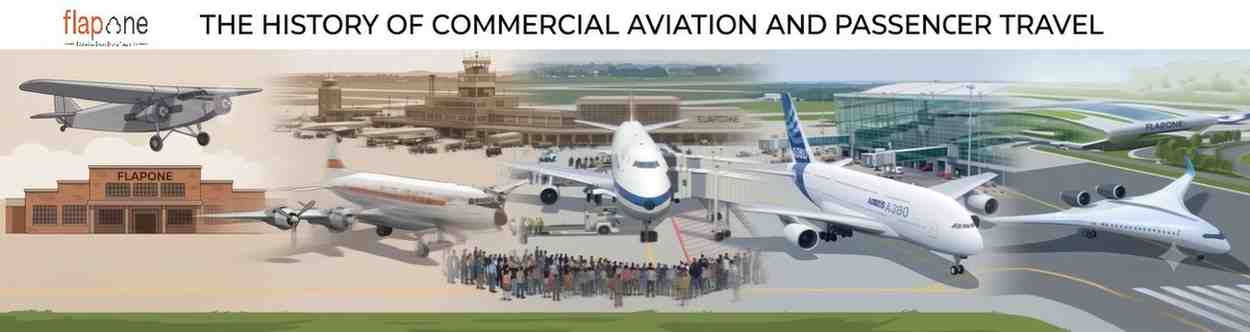
In 1903, the Wright brothers made the dream of human flight possible by inventing the first-ever aeroplane. It is no hyperbole to say that this brought about a revolution in the world, which could not have even imagined that flying was possible. Commercial aviation is much more than just a mode of transport. It also brings cultures together, advancing economies and creating new prospects. There have been many important events along the way from wooden aeroplanes to wide-body jets.
The first steps towards commercial aviation were taken in 1910, when aeroplanes were not yet common and were seen as little more than experiments. Tony Jannus flew the first commercial airline flight between St. Petersburg and Tampa, Florida, USA in 1914. There was only one paying passenger on this short 23-minute trip, but it was the start of commercial aviation and passenger travel.
In the 1920s, airlines began carrying mail. Early planes weren’t very comfortable; passenger services were seen as less important. KLM and Qantas are two airlines founded during this time that still serve passengers today. KLM is based in the Netherlands, and Qantas is based in Australia. This shows how it all started for commercial aviation.
By the 1930s, commercial air travel was a better option. The Douglas DC-3 and other planes like it changed commercial aviation by being more dependable, offering longer range and carrying more passengers in comfort. This aircraft was so prevalent that it became the model for passenger planes for several years.
Throughout this time, there has also been a development of airports. Terminals were built to handle more passengers and air travel slowly shifted to something more accessible to people. Airlines began hiring cabin crews to improve the passenger experience.
The Second World War transformed aviation because the military’s requirements sped up improvements in aircraft technology. After the war, larger, faster planes were developed and used in the commercial sector. Airlines expanded their fleets without spending much money by converting spare military planes into passenger aircraft. New navigation systems, improved safety features and a better understanding of long-distance flying were also developed. All of these enhancements made it possible for international routes to grow rapidly after the war.
The 1950s and 1960s are commonly known as the Jet Age. The aircraft, Boeing 707 and the Douglas DC-8, were the first commercial jets. This started a new era in commercial aviation. These planes could fly faster than the ones before them. Transcontinental and transatlantic flights became much shorter, making it possible for more individuals to travel globally.
The Jet Age also saw the rise of famed airlines and the idea of global branding. Businesses competed by providing not only speed and efficacy but also comfort and luxury. This time was distinct by the notion of glamorous air travel, with stylish uniforms, gourmet meals and plenty of room to sit.
The Concorde was a key advance in aviation in the 1970s. It was a joint venture of the UK and France to make this supersonic jet, able to fly across the Atlantic in less than half the time taken by a regular jetliner. Its speed exceeded the speed of sound. In 2003, due to its high operational costs, limited seating capacity and growing environmental concerns.
The Concorde was notable for its high speed, but wide-body planes like the Boeing 747 have more passenger capacity. It changed the world of long haul forever and the people were bemused upon seeing two decks and the capacity to carry hundreds of people.
Commercial air travel became more economical because more passengers could be carried on each flight. The major competitors of Boeing, the Airbus A300 and A380, were other wide-body planes that made a name for themselves in commercial air travel.
The emergence of low-cost airlines revolutionized the commercial aviation industry by making flying more affordable and accessible to millions of people. Airlines such as Southwest Airlines in the United States and Ryanair in Europe introduced cost-efficient business models that significantly reduced airfare while maintaining reliable services. By streamlining operations and offering budget-friendly ticket prices, these carriers encouraged travelers to choose air travel over trains and buses for both domestic and international journeys.
As a result, affordable air travel became available to a much broader population rather than being limited to premium travelers. This transformation fueled tourism, strengthened regional and global connectivity, and created new opportunities for businesses, trade, and economic growth. Today, budget airlines continue to play a vital role in expanding the aviation sector by connecting more destinations and making travel convenient for people from all walks of life.
For aspiring pilots, the growth of the aviation industry has also created increasing career opportunities. However, becoming a professional pilot requires excellent physical and mental fitness, along with high-quality flight training from a recognized aviation academy. Flapone Aviation provides comprehensive pilot training programs designed to equip students with the knowledge, practical skills, and confidence needed to build a successful career in the aviation industry.
The 9/11 attacks in 2001 changed security procedures a great deal and the pandemic stopped air travel globally. The industry dealt with these hitches by devising new ways to improve safety and digital services. Digital check-ins, AI-powered maintenance and customer-focused innovations made commercial aviation smarter. The industry is preparing for a future in which flying is environmentally friendly, enabled by new aircraft types and sustainable fuels.
Commercial aviation is a result of a lot of hard work, imagination and a zeal for continuous progress. It has changed the way people travel from one place to another, from the short 23-minute flight in 1914 to the long-haul flights that connect nearly every part of the world today. Every breakthrough has not only enhanced technology but also changed societies by bringing people closer together.
With more and more people choosing to travel by air, there is always a demand for commercial pilots in India and also around the globe. For becoming a commercial pilot, you can enroll with us at FlapOne Aviation to obtain a commercial pilot license and that too at a fairly competitive price, considering the quality of our instructors as well as instruction. So, what are you waiting for? Join us now.
From selecting the right drone to finding a course, our team can guide you through every step of your drone journey.