Which are the 5 Most Destructive War Drones?
Drones are no longer just surveillance reconnaissance vehicles, but also precision-guided destructive weapons. Armies around the world
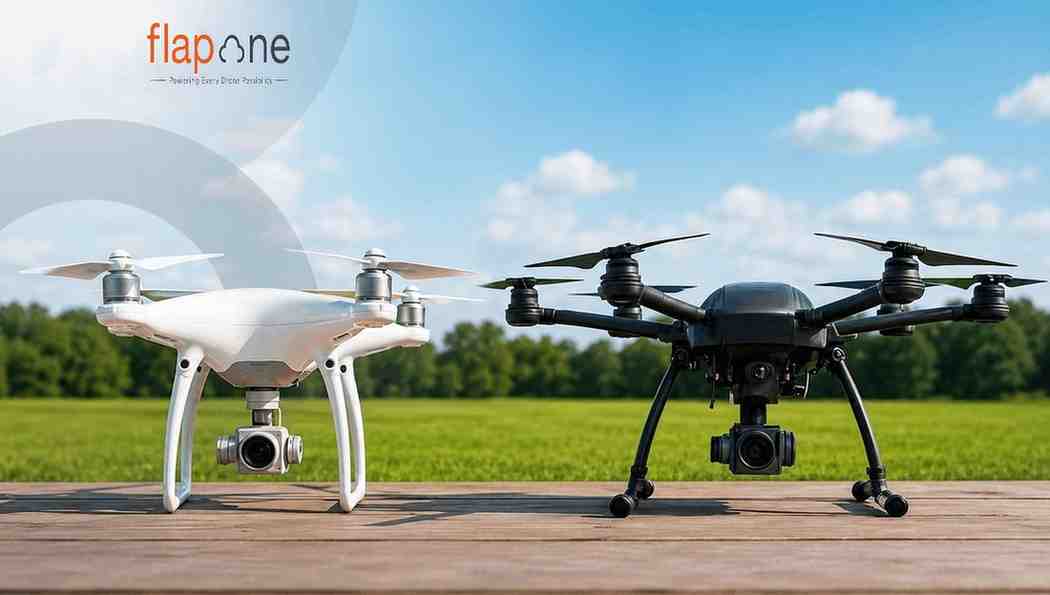
Talking about the commercial spectrum, drone photography, drone inspection, drone mapping, drone security and agricultural drones are changing the way various industries operate. When choosing a commercial drone, the decision between a flexible, lightweight quadcopter and a stable, reliable hexacopter? Here is a detailed look at the performance and value debate amongst quadcopter and hexcopter commercial drones.
Quadcopter Drones
These types of drones have four rotors. Their simple structure is put to use in most consumer and commercial drones, making them light, portable and easy to maintain. They achieve flight through differential speed control of the front, rear, left, and right rotors, making them suitable for quick manoeuvrability and entry-level operation.
Hexcopter Drones
The number of rotors in a hexcopter surges from four to six, characteristically arranged in a "V" or "Y" shape. Hexacopter commercial drones are more stable and have a higher payload capacity. The control of hexacopter drones is more intricate. Even if one motor fails, they can safely return to base. Quadcopters have better agility and are also economical, while hexacopters are more stable and durable.
The performance comparison among quadcopter and hexacopter commercial drones will be explained from the perspectives of control systems, flight performance, camera payload, replaceable payloads and image transmission performance.
Quadcopters have better wind stability, with wind resistance of 5-7. They have low payload capacity, superior cameras and a flight time of 30 minutes, making them suitable for aerial photography, rapid deployment and portable transport. A hexacopter can hover more steadily in the air and can carry more weight. They carry radar, cameras or multispectral sensors, allowing long-duration, continuous and complex mission operations.
Commercial drones are used in several industry service scenarios, for example, aerial photography and film production, surveying and modelling, power and pipeline inspection, public security and emergency rescue, security patrols, agricultural applications and education and training. By carrying diverse drone payloads, they attain more accurate results.
Whether it's a quadcopter or a hexacopter drone, users can discover an appropriate solution based on their own requirements. Quadrotor drones are suitable for small and medium-sized enterprises with limited budgets and wide-ranging missions; hexacopters are aerial assistants custom-made for high-precision, high-risk scenarios.
Quadcopter drones have a simple structure, cost between USD 2,000 and USD 20,000 and have low maintenance costs and limited payload capacity, making them suitable for high-frequency, short-duration missions. Hexacopter drones have higher equipment costs and more complex maintenance, but they can decrease risks and downtime costs in high-value missions.
Choosing the right drone starts with understanding your business goals. If you need to survey large sites, inspect infrastructure, or generate accurate mapping and statistical data, a fixed-wing survey drone offers excellent coverage and efficiency. For offshore inspections or marine operations, a waterproof drone capable of safe water landings provides reliable performance in challenging environments.
If your priority is creating high-quality aerial photography or cinematic videos for real estate, construction projects, tourism, or corporate marketing, a drone equipped with a high-resolution 360-degree camera delivers immersive and professional results. For demanding applications such as industrial inspections, emergency response, or search and rescue missions, choose a rugged commercial drone designed to handle strong winds, harsh weather, and challenging terrain.
Before investing in a drone, clearly define how you plan to use it—whether for surveying, mapping, inspections, aerial imaging, security, or emergency operations. Matching the drone's capabilities to your operational requirements will help you improve efficiency, maximize your return on investment, and select a solution that supports your business both now and as your needs grow.
The mobility, portability, and cost-effectiveness of quadcopter drones, and the redundancy, safety, heavy-load mission capabilities, and all-weather performance of hexacopter drones are continually enhancing the value of the commercial drone market and supporting operations across several industries. If you want to get one of these drones up your sleeve or earn a drone pilot license, come to us at FlapOne Aviation.
Not sure which drone fits your needs? Our experts can guide you to the perfect UAV for your mission.