Drone - News & Announcements

Stay informed with the latest updates, events, and developments from our training programs and drone/aviation services.

Varanasi Police Deploy New-Generation Drones for Kashi Tamil Sangamam Security
Drone Products Drone Production

Varanasi Police Deploy New-Generation Drones for Kashi Tamil Sangamam Security

The Varanasi district police have stepped up surveillance for the ongoing fourth edition of Kashi Tamil Sangamam by deploying an advanced fleet of new-generation drones. According to Deputy Commissioner of Police Varanasi Commissionerate Saravanan Thangamani, a dedicated 10-member drone team is ensuring the safety and protection of the people visiting the venue. "We are using new-generation drones. Last year, there was drone use, but it was minimal. We are using the three types of drones, which are mini drones, micro drones and nano drones," Mr Thangamani told the  PTI . Highlighting the role of the drone fleet, Mr Thangamani said the Mini Drone is unique as it can be self-charged, allowing round-the-clock operations unlike other battery-dependent models. "This drone can run 24x7 and ensure constant surveillance in a region," Mr Thangamani explained. On the 'Macro Drone', the official said it is capable of monitoring a vast 2 km area. "It can cover a larger area and will be used in the jungle behind the NaMo Ghat (multi-level riverfront development on the Ganges in Varanasi)," said Mr Thangamani, who is also the Nodal Officer for the Kashi Tamil Sangamam event. NaMo Ghat is the site where Kashi Tamil Sangamam 4.0 was inaugurated by the Uttar Pradesh Chief Minister, Yogi Adityanath, on December 2. The third kind of drone is 'Nano Drones', which can collect images of suspicious activity. Citing an example, Mr Thangamani said if a car is parked in an area for an unusually long time, this drone scans the vehicle and shares the image with the police. "Based on the images it shares, we take action." He also noted that the surveillance data from the three drones is immediately shared with senior police officials for necessary action. Source: The Hindu

Saheel Singh 08 Dec 2025
JSW Setting up USD 90 Million Military Drone Plant in Hyderabad
Drone Products Drone Training

JSW Setting up USD 90 Million Military Drone Plant in Hyderabad

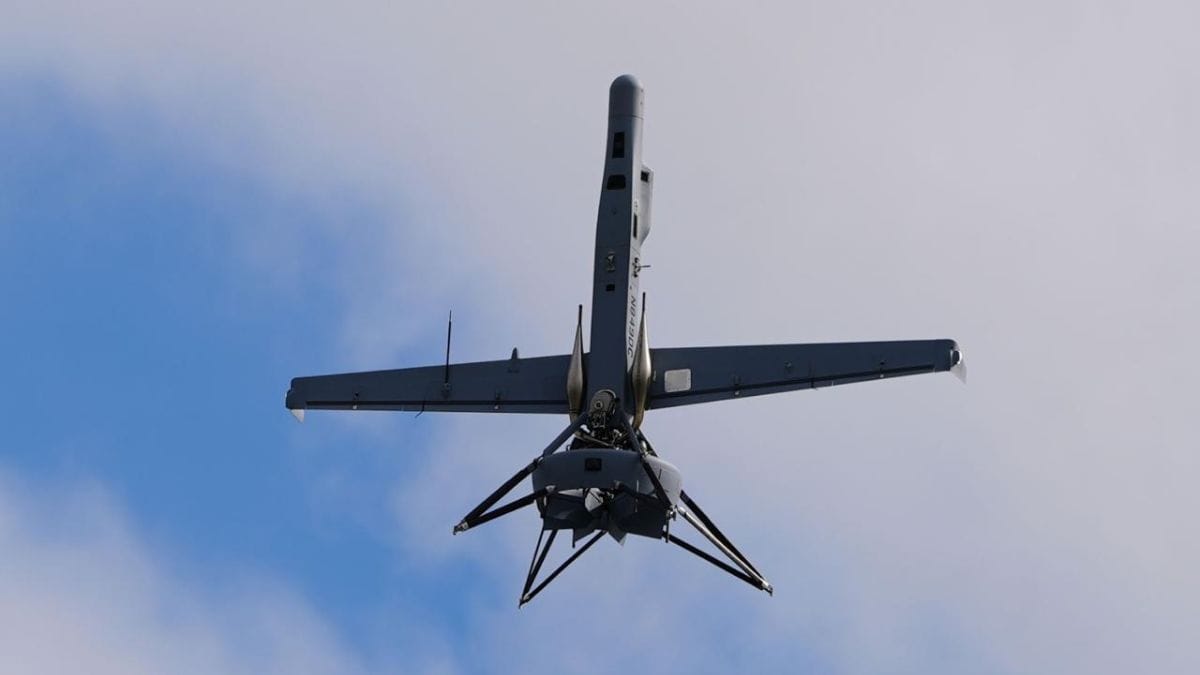
The USD 23 billion JSW Group is setting up an unmanned aerial systems manufacturing facility with an investment of about Rs. 850 crores at the Maheshwaram electronics manufacturing cluster, on the outskirts of Hyderabad. The USD 23 billion JSW Group is setting up an unmanned aerial systems manufacturing facility with $90 million investment at the Maheshwaram electronics manufacturing cluster, on the outskirts of Hyderabad. It has entered into a strategic partnership with the US-based defence technology firm Shield AI to manufacture Shield AI’s Group 3 unmanned aerial system under a long-term licensing arrangement for technology transfer. A fixed-wing, vertical take-off and landing long-endurance intelligence, surveillance, reconnaissance platform, V-BAT, is currently deployed by multiple armed forces globally, including the U.S. Marine Expeditionary Units. The manufacturing, at the facility of JSW Defence, is expected to commence by the last quarter of 2026, JSW Group said after the foundation stone laying ceremony in which IT and Industries Minister D. Sridhar Babu, JSW Group’s Parth Jindal and others participated. The USD 23 billion JSW Group is setting up an unmanned aerial systems manufacturing facility with an investment of about Rs. 850 crores at the Maheshwaram electronics manufacturing cluster on the outskirts of Hyderabad. It has entered into a strategic partnership with US-based defence technology firm Shield AI to manufacture the latter’s Group 3 unmanned aerial system under a long-term licensing arrangement for technology transfer. A fixed-wing, vertical take-off and landing long-endurance intelligence, surveillance, reconnaissance (ISR) platform, V-BAT, is currently deployed by multiple armed forces globally, including the U.S. Marine Expeditionary Units. The manufacturing, at the facility of JSW Defence, is expected to commence by the last quarter of 2026, JSW Group said after the foundation stone laying ceremony in which IT and Industries Minister D. Sridhar Babu, JSW Group’s Parth Jindal and others participated. The investment will enable JSW to establish a local supply chain and create an advanced facility in India for manufacturing, assembling and testing V-BAT. The effort will enable large-scale production of V-BATs in India to serve the needs of the Indian Armed Forces and also function as a global production hub, the Group said. Project Will Create over 300 High-Value jobs. The facility is spread over 16 acres and will have a capacity to manufacture 300 V-BAT drones annually. It will house production, repair, testing, administrative, and support infrastructure. This project will create over 300 high-value jobs, the Minister’s office said. “From manufacturing the globally renowned V-BAT at scale, the facility will lay the foundation for an integrated, end-to-end UAS ecosystem, from advanced manufacturing to operator training, manufacturing repair and operations (MRO) and sustained innovation. This project stands among the most significant defence technology transfers to India,” Mr Jindal said. On the Group’s defence ventures, he said the drone manufacturing project follows the JSW Gecko Motors joint venture, with a Ukrainian company, to make special mobility vehicles in Chandigarh. The facility was commissioned about 18 months ago and supplied nearly 200 vehicles to the Indian Army and the United Nations. In the same facility, JSW has another JV with an American firm to manufacture off-road vehicles. Total Rs 1,200 Crore investment The Group will invest a total of Rs. 1,200 crores in defence ventures, including Rs. 320 crores for technology transfer from Shield. He said India Armed Forces were evaluating the UAS from a localization perspective. The initial order is for importing eight UAS through the emergency procurement route, which is directly catered for by Shield AI. The larger orders will be placed once the facility is up, he said. Telangana Aims to be a Defence Hub The IT and Industries Minister said Telangana is working towards positioning itself as a strategic defence hub of India by developing a strong ecosystem for unmanned systems and advanced defence manufacturing. The State government is preparing a comprehensive roadmap to transform Telangana into a global leader in defence innovation, with a special focus on unmanned aerial systems, drone technologies and aerospace manufacturing. There are plans to establish a drone manufacturing and testing corridor to boost indigenous defence capabilities, Mr Sridhar Babu said. Source: The Hindu

Saheel Singh 08 Dec 2025
India’s 900-km Loitering UAV to Fly on Homegrown Wankel Engines, Reducing Foreign Reliance
Drone Flying Drone Pilot

India’s 900-km Loitering UAV to Fly on Homegrown Wankel Engines, Reducing Foreign Reliance

India is planning to develop cutting-edge long-range drones and 150-kilogram class loitering munitions powered by indigenous Wankel rotary engines, strengthening its strategic drive toward self-reliance in defence technologies. The initiative will reduce the need for foreign suppliers of propulsion systems. This segment is a bottleneck in India’s drone ecosystem, despite key progress in domestic airframe, software and weapons development. The first system to appear from this effort is a 150-kilogram loitering munition-drone hybrid platform, tentatively named ‘Loitering Munition-UAV’. Early specifications specify a standoff strike range of about 900 kilometres and an in-air time of about 9 hours per mission. If validated in trials, the platform would fall into the long-loiter category, providing deep-reach precision-strike capability, extended surveillance, target tracking and instantaneous engagement flexibility. The CSIR-National Aerospace Laboratories will partner with a private company to advance and manufacture long-range drones, marking a shift toward deeper industry participation in strategic drone programmes. The partnership signals a move away from largely PSU-led prototypes to a model combining a state-backed R&D strength with private-sector speed, scale and production capability. Wankel rotary engines are a favoured power source for small- and medium-sized drones worldwide because of their compact size, high power-to-weight ratio, low vibration signature and mechanical simplicity compared to traditional piston engines. India’s decision to localize this technology is significant because these engines power many imported loitering systems at present in use or under assessment by the country. Indigenizing the propulsion stack ensures that future Indian unmanned platforms can operate with sovereign supply-chain security, resist geopolitical leverage and integrate more seamlessly with classified mission systems. This would benefit defence PSUs and startups alike by lowering development costs, shortening iteration cycles, and enabling deeper integration with domestically developed strike, navigation and sensor packages. It may also unlock India's export potential in the unmanned-propulsion market, mainly amongst countries seeking non-Western supply alternatives. The headline range figure of 900 kilometers will also depend on aerodynamic efficiency, flight profile optimization, and fuel tank design, making full-scale validation during flight trials essential. The strategic value of the programme lies not only in the 150-kilogram strike platform itself, but in providing a domestic propulsion system that future drone families could inherit. Once flight-tested and production-qualified, the Wankel engine could expand into maritime-surveillance UAVs, swarm-drone nodes and potentially heavier rotary-powered loitering or cruise-type platforms. For now, the announcement carries significant signaling; India is committing to indigenous propulsion in the long-range unmanned-strike segment. The next milestones that will shape market and military confidence will be prototype flight trials, thermal-performance benchmarks, real-world endurance validation and the decision to transition the programme into scaled production.   Source: Indian Express

Saheel Singh 02 Dec 2025
India's First Fully Mobile, AI-Enabled Anti-Drone Patrol Vehicle Launched
Drone Flying Drone Pilot

India's First Fully Mobile, AI-Enabled Anti-Drone Patrol Vehicle Launched

In a substantial upgrade to India's border defence strategy, Indrajaal Drone Defence on 26 November 2025 announced the launch of the 'Indrajaal Ranger', the nation's first Anti-Drone Patrol Vehicle. This innovative, fully mobile, AI-enabled counter-drone system will detect, track, and neutralize hostile drones while they are actively in motion, addressing a critical national security vulnerability. The 'Ranger' is a combat vehicle intended to break away from traditional, stationary anti-drone solutions. Its core competence lies in delivering on-the-move drone detection, instantaneous patrolling and instantaneous interception- a requirement driven by the growing sophistication of cross-border threats. The company's insistence to develop the ADPV was heightened by recent national security incidents that highlighted drones as a key channel for illegal activity. Incidents involving ISI-linked weapon smuggling deep into Indian territory and the reliable neutralization of hundreds of Pakistani drones this year, serving as the main transport for India's massive Rs 3-lakh-crore drug-trafficking network, made the requirement for a fast, mobile response undeniable. Speaking at the launch, Lieutenant General Devendra Pratap Pandey (Retd), PVSM, UYSM, AVSM, VSM, praised the innovation. "India's youth deserve a safer nation, free from the shadow of international crime networks," said Lt Gen. Pandey. "Technologies like the Anti-Drone Patrol Vehicle are not just machines; they are shields protecting our children, our farmers and our future. With this new Ranger launch, India and the brave men guarding our borders will be truly grateful for such a transformative contribution." The Indrajaal Ranger will deliver a transformative layer of national security. By cutting off logistical supply routes and monetary channels for criminal operations, it weakens recruitment pipelines of smuggling and extremist networks, reinstating a sense of safety and dignity to vulnerable border communities. Indrajaal is an autonomous counter-UAS and air-defence technology company. Its proprietary autonomy engine, SkyOS, fuses multi-sensor intelligence and instantaneous decision-making into a unified C5ISRT framework.  This lets the company create dynamic "security domes" that protect intricate environments, such as airports, refineries, and military formations, at unprecedented scale. The company has already achieved operational success and is well-positioned for national-level rollouts, having obtained ARDTC certification for the disposition of Counter-UAS systems. Source: NDTV

Saheel Singh 28 Nov 2025
India to Install Anti-Drone Systems at All Airports Due to Rising Security Concerns
Drone Products Drone Training

India to Install Anti-Drone Systems at All Airports Due to Rising Security Concerns

The Union Ministry of Home Affairs and the Bureau of Civil Aviation Security have decided to install anti-drone systems at all major and minor civil airports across India. The decision was taken in a high-level joint meeting and comes in the wake of increasing security risks and the likelihood of future war-like situations, senior officials said on Sunday. The government’s decision has been influenced by the experience gained during Operation Sindoor, following the April 2025 Pahalgam terror attack, where 26 civilians were killed. After the attack, India and Pakistan were involved in a tense military exchange. Indian forces carried out strikes on terrorist bases inside Pakistan and Pakistani drones were flying over Indian territory, several of which were shot down by India’s defence systems. These events highlighted how drones are being used as tools in contemporary warfare and how they pose risks to civilian areas, including airports. While the lasting plan is to cover all airports, officials said the project will be implemented in phases. In the first phase, anti-drone systems will be installed at Delhi, Mumbai, Amritsar, Jammu and Srinagar airports. These sites were chosen because they have faced higher security threats and were directly involved in the military escalation. First time anti-drone tech will be used at purely civilian airports This is the first time India will position anti-drone systems at airports handling only civilian passenger traffic. Until now, such systems were primarily used by defence and border security agencies. The systems will help detect, track and neutralize any rogue drone entering airport airspace, a significant step as drones have become effective tools in new-age conflict. The MHA is leading the project, while BCAS has formed a committee to handle planning and execution. This committee includes representatives from: • Directorate General of Civil Aviation (DGCA) • Central Industrial Security Force (CISF) • Airport security and technical experts • Other relevant stakeholders The government is at present reviewing the technical specifications of the anti-drone equipment. Once confirmed, the MHA will coordinate with the Ministry of Civil Aviation and direct airport operators to connect systems that meet national security requirements. The government is also studying anti-drone models already in use at key airports abroad to accept the most effective technology. Deadlines for installations at various airports will be set after the specifications are approved. Source: mathrubhumi.com

Saheel Singh 27 Nov 2025
NIT-C Students Develop Autonomous Drone for Disaster-Relief Operations
Drone Products Drone Training

NIT-C Students Develop Autonomous Drone for Disaster-Relief Operations

Formed in August, the 15-member team will design a compact aerial system capable of assisting rescue agencies during floods, landslides and other climate-induced emergencies, said a release. The project received vital technical and financial backing from Kokos.AI, whose R&D team worked closely with the students to ensure technological precision and a unified implementation. The group, known as Team Paravai, presented the drone at the SAE Aerothon 2025 in Chennai. Weighing 2 kg, the drone has a frame constructed from 3D-printed PA12 and a carbon fiber composite, providing durability and reduced weight. The quadcopter features several features tailored for practical rescue scenarios. The aircraft supports communication over a 1-km range and can stream live video. A LIDAR-based collision-avoidance system helps navigation in complex terrain, while sensors detect human presence up to 15 metres away. The drone can also transport aid packages of up to 200 grams with high drop precision. Its fully autonomous control system decreases the requirement for continuous operator involvement during hazardous operations, the release said. NIT Calicut officials defined the project as a substantial step towards enhancing technology-driven disaster management. Team Paravai will expand the drone’s endurance and incorporate cutting-edge payload capabilities. Source: The Hindu

Saheel Singh 26 Nov 2025
What’s New in the Proposed Drone Bill 2025?
Drone Pilot Drone Products

What’s New in the Proposed Drone Bill 2025?

In September 2025, India’s Ministry of Civil Aviation unveiled a Draft Civil Drone Bill, 2025 and the drone industry’s reaction was immediate and visceral. Rather than applause for a long-pending, dedicated drone law, the proposal triggered swift and significant reaction from startups, tech associations and even hobby clubs. Critics argued that the new bill marked a step backwards from the liberal approach that had pushed India’s drone boom since 2021.   Why are Drones So important? The drone sector matters because it can touch many areas, from food production to public safety to healthcare to national security. It’s why India is working on making a booming drone ecosystem and why China is building a low-altitude economy. Before 2021, drones existed in a legal purgatory. The few operators who tried to navigate the system faced 25 forms, 72 fee types and a permission process so opaque that most gave up. The government saw drones as potential security threats, but not much else. Then came the Drone Rules of 2021. The government had become more open to trying out how drones could be configured for the national economy. Now, drones can be used for many purposes and can be of various types, but the rules categorized them and introduced a tiered system based on one simple metric: weight. Nano drones were exempt from registration entirely. This registration gives each drone a “unique registration number”. Hobbyists could also fly micro drones (250g-2kg) without a pilot license. The impact was instant. While drone startups multiplied, the DGCA approved 116 training schools, minting over 16,000 certified pilots. The 120-crore PLI scheme attracted manufacturers, and an import ban on finished drones forced global players to assemble in India. In three years, India went from a drone desert to one of the largest drone markets in the world. The Plot Twist of 2025 In contrast to the 2021 framework, the 2025 bill, while claiming to be more relaxed, is more restrictive. Industry stakeholders have highlighted several problems with it. Universal Registration : Under the new bill, even a small toy drone must be registered before it can be sold. This shifts compliance upstream to manufacturers, who build registration into every product. The toy drone market, worth crores and a gateway for young engineers and students, might shrink as a result. Mandatory Pilot Licensing for Everyone : A person flying a micro-drone would need a Remote Pilot Certificate, just as the self-help group working under the Namo Drone Didi scheme would. For potential entrepreneurs who plan to fly their own drones for testing, this is a letdown. Type Certification Before Manufacturing : No drone can be manufactured, assembled, sold, or operated without DGCA certification. You can’t even build a prototype to test. Criminal Penalties for Paperwork Errors : Flying an unregistered drone is a cognizable offence.   One can be arrested and have one's drone seized without a warrant. Under the 2021 rules, such violations were subject to administrative fines. Universalinsurance : Every operator must have third-party insurance covering 2.5 lakh for death and 1 lakh for injury, on a no-fault basis. For a researcher or a rural SHG operating on a limited budget, this is a tall ask. It seems like the new bill puts a price on innovation, rather than regulating with balance. Why This Matters Beyond Drones The controversy reveals a deeper tension in India’s economic policy. Since 2014, the government has supported “ease of doing business” and “Make in India.” The 2021 drone rules were advancing both those goals. The 2025 bill, though, represents a reversal of that. The US Federal Aviation Administration frees recreational flyers from licensing. The EU’s Open Category requires a simple online test for low-risk drones. China also lets hobbyists fly without pilot certificates. India’s draft bill would make it an outlier. The economic stakes are huge. Agriculture alone seems to need thousands of drones for the Kharif season. The defence sector is building an indigenous drone arsenal worth thousands of crores. Logistics companies are betting on drones that could revolutionize e-commerce delivery. All this needs a pipeline of innovators students tinkering in labs, startups repeating in green zones, SHGs learning by doing. In March 2021, the government notified the UAS Rules, 2021, a predecessor to the existing draft that was so restrictive it was dead on arrival. Industry pushed back so fiercely that within months, the government scrapped it and replaced it with the liberalized Drone Rules we have today. The 2025 draft has faced near-universal criticism. NASSCOM has called for withdrawing the bill entirely. The consultation period, which was set at just two weeks, has been extended. Industry bodies are pushing for precise amendments: restoring R&D exemptions, decriminalizing minor violations, creating a classified penalty system and so on. There is a possibility that the bill will either be heavily revised or, like its 2021 predecessor, quietly shelved. The Ministry of Civil Aviation comprehends that India’s drone dream cannot survive if the very people building it are treated as criminals. This sets a precedent for how India controls emerging technologies, and we’ll be asking this question a lot more as AI and humanoids rise. The 2021 rules showed what happens when regulators trust citizens: innovation explodes and India becomes competitive. The 2025 bill shows what happens when fear trumps that trust. This new bill straddles the old line between regulation and innovation. The question is whether we require regulation that pre-emptively protects us from a future that doesn’t exist or regulation that lets us build it. Source: www.civilaviation.gov.in

Saheel Singh 24 Nov 2025
ideaForge Wins USD11M Indian Military Drone Deal
Drone Products Drone Training

ideaForge Wins USD11M Indian Military Drone Deal

India’s military has placed a key new order for IdeaForge’s latest unmanned systems after putting them through demanding trials in electronic-warfare conditions. IdeaForge confirmed that it will supply its next-generation Zolt tactical drone and the SWITCH 2 vertical-takeoff UAV under a capital emergency procurement worth roughly 1 billion rupees, according to a report by the Economic Times. Zolt accounted for about 750 million rupees of the order, following field assessments that tested its performance in high-altitude and heavily jammed environments. SWITCH 2, already in service with the army, received a follow-on order valued at 300 million rupees. Rather than being a routine replenishment, the deal seems tied to India’s broader effort to harden its ISR and precision-delivery capabilities along contested borders. Zolt’s design reflects that shift as the platform is built for long-range intelligence, surveillance and reconnaissance missions and can carry precision payloads. IndiaForge’s Other Deals with India IdeaForge has progressively expanded its footprint across India’s defence and security ecosystem over the past several years. In June 2025, the company secured an emergency order from the government worth 1.37 billion rupees for mini unmanned aerial vehicles. The deal will see ideaForge deliver fixed-wing vertical take-off and landing drones within 12 months. Apart from the military, government agencies, such as the National Disaster Response Force, state police units and infrastructure authorities, have adopted ideaForge drones for tasks ranging from mapping and search-and-rescue to monitoring critical assets.   Source: The Defense Post

Saheel Singh 24 Nov 2025
NIT Rourkela Develops Autonomous AI-powered Land Mapping Drone System
Drone Products Drone Training

NIT Rourkela Develops Autonomous AI-powered Land Mapping Drone System

NIT Rourkela has developed Bhu Manachitra, an autonomous instantaneous land-mapping drone system. The innovation integrates AI and UAV technology to produce land maps without requiring internet connectivity, external computers or manual intervention. The research team has advanced a deep learning model allowing the drone to recognize land features in real time. Different from conventional drones that take images for later processing, BHU-Manachitra completes all analysis on board, making it autonomous and appropriate for remote, disaster-hit regions and areas lacking communication networks. Speaking about the development, Sambit Bakshi, Associate Professor, Computer Science & Engineering, said, “The invented methodology makes use of a lightweight AI model with 2.48 million parameters, which makes Bhu Manachitra suitable for on-board processing in drones. Drones, being intended lightweight for long flight time, cannot carry heavy dedicated hardware for instantaneous image processing, but can carry a tiny processor for executing this lightweight AI model that performs land mapping.” The technology will support multiple sectors. Government agencies can deploy it for land record modernization, urban planning and smart-city development. Agriculture departments can use it to evaluate crop conditions, soil health and irrigation needs, aiding productivity and sustainability. Throughout natural disasters, the system can offer instant terrain intelligence, enabling faster and more effective response planning. Environmental and forest departments can also use it to track deforestation, encroachments and changes in biodiversity. NIT Rourkela and IIT Patna Vishlesan I-Hub Foundation have jointly secured an Indian patent for the technology. TIH IIT Patna sponsored the research under the National Mission on Interdisciplinary Cyber Physical Systems of the Department of Science and Technology, Government of India.   Source : Economic Times

Saheel Singh 24 Nov 2025
India’s First ‘Sky Factory’ Will Build 1,000 Electric Air Taxis a year in Andhra Pradesh
Drone Technology Drone Training

India’s First ‘Sky Factory’ Will Build 1,000 Electric Air Taxis a year in Andhra Pradesh

Andhra Pradesh will build India’s first “giga-scale” electric air taxi manufacturing cluster in Anantapur, with Karnataka-based Sarla Aviation committing an investment of INR 1,300 crore. The partnership was announced on 18 th November 2025, following the signing of an MoU by Sarla Aviation and the Andhra Pradesh Airport Development Corporation Ltd at the CII Partnership Summit 2025 in Visakhapatnam. The development follows Chief Minister N. Chandrababu Naidu’s new announcement that the state will begin producing drone taxis in two years. At the centre of the plan is the upcoming “Sky Factory”, which Sarla says will rank amongst the world’s largest facilities for electric vertical take-off and landing (eVTOL) aircraft. In the first phase, the company will invest 330 crores to set up a 150-acre manufacturing and testing campus at Thimmasamduram village in Kalyanadurg mandal. The site will have production lines, R&D labs, composite units and a dedicated 2-km runway for testing and certification. A second phase will increase the facility by another 350 acres. Once fully operational, the Sky Factory will produce up to 1,000 aircraft a year, including Sarla’s Shunya hybrid VTOL and a range of indigenously built electrical harnesses, landing gear systems and composite structures. The project will generate high-value employment by 2027, starting with 40 specialized positions and 140 indirect jobs. Rakesh Gaonkar, cofounder and CTO at Sarla Aviation, said the project is designed to place India at the centre of next-gen aviation. “With the world’s biggest Sky Factory, we want to make India the nerve centre for the next era of flight. This giga facility will shape the aircraft of the future and establish India as a force in sustainable aerial mobility,” he said. APADCL will act as a tactical facilitator to fast-track the project and build the surrounding ecosystem. The state government said the association marks a major step in its push to establish Andhra Pradesh as a hub for cutting-edge manufacturing, aerospace innovation and green mobility.   Source: Business Today

Saheel Singh 21 Nov 2025
DroneNova India to Launch Nation's First Drone Soccer League at ESFE 2025
Drone Pilot Drone Training

DroneNova India to Launch Nation's First Drone Soccer League at ESFE 2025

DroneNova India Pvt. Ltd. has announced the launch of India's first-ever Drone Soccer League (DSL) and opened enrolments for its on-campus Drone STEM Workshops. The initiatives will be unveiled at the upcoming Education Supply & Franchise 2025, where DroneNova is the official sponsor. The ESFE 2025, scheduled from December 11 to 13, 2025, at the Bombay Exhibition Centre, Mumbai, will bring together the most influential leaders, educators and policy influencers shaping the future of Indian education. The event will have the likes of Dr Niranjan Hiranandani as Guest of Honour, alongside distinguished speakers Sonal Pinto, Director, Ryan Group of Schools; Lina Ashar, Founder, Dreamtime Learning and Syed Sultan Ahmed, Chairperson, TAISI. The three-day expo will provide transformative solutions for India's quickly evolving education ecosystem. DroneNova's revolutionary Drone Soccer League, a first-of-its-kind initiative, transforms classrooms into live arenas of innovation. With the help of this program, students will pilot safe, sub-250g drones in a net-caged field, learning physics, coding, teamwork and strategy in an appealing, competitive environment. We want to make India a global hub for drone-based experiential education that inspires curiosity, collaboration and creativity in every learner," said Himansshu Jainn, Founder, DroneNova India. "Every flight is a science lesson; every goal is a leadership moment. With Drone Soccer, students don't just learn concepts, they live them." The program aligns with the priorities of NEP 2020 on experiential learning and 21st-century skill-building, complements Skill India pathways and adheres to India's evolving Drone Policy framework. Intended as a turnkey offering, it offers schools with equipment, safety infrastructure, certified trainers and curriculum-linked modules aligned with NEP, IB MYP, and IGCSE standards, ensuring both academic depth and operational ease. To catalyze a national movement, DroneNova is inviting 10 visionary institutions to join as "Founding Partner Schools" DroneNova India to Launch Nation's First Drone Soccer League at ESFE 2025. Advertorial Disclaimer: visionary institutions to join as Founding Partner Schools, who will obtain exclusive benefits as well as priority workshop scheduling, lifetime partnership privileges and guaranteed regional qualifier slots for the Drone Soccer League. By sponsoring ESFE 2025, DroneNova India will showcase how drones, STEM and sport can converge to redefine classroom learning and inspire a new generation of innovators. Source: ANI

Saheel Singh 19 Nov 2025
Air India Pilots Grounded Over Expired Licences, Unchecked Training
Aircraft Flying Aviation Training

Air India Pilots Grounded Over Expired Licences, Unchecked Training

Scheduling lapses continue to trouble Air India, nearly five months after the DGCA reprimanded the carrier for regulatory violations. Two pilots have now been grounded, one for flying with a lapsed English Language Proficiency license and another for operating a flight without completing mandatory corrective training after failing a proficiency check. Two Air India Pilots Grounded The latest incidents highlight persistent gaps in Air India’s rostering and compliance monitoring systems. The airline confirmed that an Airbus A320 co-pilot operated a flight despite failing his Instrument Rating–Pilot Proficiency Check and skipping the required retraining. As stated by the procedure, pilots who fail the PPC must complete corrective training and undergo another evaluation before returning to flight duty. Air India stated that both the co-pilot and the scheduling officer responsible were “off-rostered” as soon as the error was detected, and disciplinary action was initiated. The airline said the event had been reported to the DGCA for review. In another case, a senior captain commanded an A320 flight despite holding an expired ELP certificate, a mandatory qualification for operating any commercial flight. Air India confirmed the violation with TOI, grounding the pilot and reporting the incident to the regulator. Regulator’s Ongoing Oversight The DGCA has sought a detailed report from Air India on both incidents, calling them serious breaches of flight safety compliance. The regulator had earlier identified “systemic failures” in Air India’s scheduling processes, including lapses in licensing, rest, and recency requirements. Following a June 12 incident involving a near miss after takeoff from Delhi, the DGCA had warned Air India of strict enforcement measures. The regulator removed three senior officials from their crew scheduling duties and warned that future violations could result in heavy penalties or the suspension of the airline’s operator license. Systemic Accountability and Future Compliance Aviation safety experts are of the opinion that repeated oversights indicate deeper issues in Air India’s internal monitoring mechanisms. They contend that compliance systems must flag expired qualifications automatically before any pilot is rostered for duty. While Air India has taken internal action and reinforced its audit processes, the recurrent nature of these errors continues to raise concerns over the dependability of its flight operations management. The DGCA’s constant scrutiny suggests that stricter enforcement could follow if systemic improvements are not apparent soon. Source: Times of India

Admin 18 Nov 2025
Air India introduces ‘Flexi Contract for Pilots’ to Help Balance Operations
Commercial Pilot Aviation Training

Air India introduces ‘Flexi Contract for Pilots’ to Help Balance Operations

Air India has devised a “Flexi Contract for Pilots,” a new work model that allows flight crews to select shorter duty patterns while upholding smooth operations. The airline says the plan will match pilots’ preferences with roster needs, focusing on work-life balance without compromising competence. Under the policy, Line Pilots and Line Training Captains on A320, B777 and A350 fleets are eligible. Junior First Officers, Type Rating Instructors and Direct Entry pilots are not. The contract provides two fixed patterns: for wide-body aircraft, 15 days on and 15 days off; for narrow-body aircraft, 20 days on and 10 days off. Annual leave line up with these rosters–eight privilege and four sick leaves for wide-body pilots and 12 privilege plus six sick leaves for narrow-body colleagues. The tenure of the contract will be 12 months, which can be extended at the company’s discretion. After the contract ends, pilots return to their original terms. Air India states that selection is made through an Expression of Interest process, with seniority and operational requirements guiding the final list. An exit needs three months’ notice. If a pilot is selected for a fleet or command upgrade, the pilot returns to the original contract from the start of training; if an upgrade is refused, the prevailing career policy on freezes applies. The company might also revert a pilot to the old contract if required and this does not change the pay terms that applied before switching to flexi terms. Pay follows a calculator shared with crew, with minimum monthly availability set at 12 days for wide-body and 15 days for narrow-body to obtain 40 hours of pay under the new structure. Flying more than 40 hours is paid at the same rate as on the original contract. Trainer, wide-body, deadhead and layover allowances stay protected. Car lease and NPS EMIs are adjusted against flexi salary components. On off-days, pilots remain exclusively engaged with the airline and are not permitted to take on outside work. Leave bidding under the flexi track runs on an ad-hoc system, and previous bids are forfeited. Total bid points throughout the tenure are 20 for wide-body and 30 for narrow-body. Loss of License coverage continues, including on off-days. Medical insurance remains unchanged. Seniority is protected, and base and merit/demerit processes remain as per the current policy. When pilots return to the old contract, they join the next regular leave-bidding cycle. The process runs in two cycles, one beginning in January 2025 and the other in March 2025. Slots are allocated by seniority. As stated in the plan, commanders have 50 A320 slots at Bengaluru, Delhi, and Hyderabad, 30 B777 slots at Mumbai and Bengaluru, and 20 A350 slots at Delhi. First officers have 20 A320 slots at Bengaluru, Mumbai and Hyderabad, 70 B777 slots at Delhi, Mumbai and Bengaluru and A350 slots to be announced for Delhi. Source: The Print

Admin 18 Nov 2025
Drone Kabaddi will be Launched in Uttarakhand
Drone Training Drone Products

Drone Kabaddi will be Launched in Uttarakhand

In Operation Sindoor, the Indian Army's military action against terrorist bases in Pakistan involved the use of indigenous drones to a large extent. In this regard, the Uttarakhand government has conceptualized the sport of Drone Kabaddi to provide technical training to the state's youth and offer them employment opportunities. In future, trained players can be utilized as drone pilots in crisis situations like disasters, war exercises, etc. Drone Kabaddi is likely to be launched in Uttarakhand for the first time in the country. All preparations for its rules and drone selection have been completed. It will launch soon. Being a mountainous state, Uttarakhand is highly vulnerable from a disaster perspective. Sometimes, situations arise where human power cannot be utilized even if desired. In such complex situations, only technology is useful. However, technology also requires skilled personnel to operate and control it. Similarly, the Sports Department has signed an agreement with D-Town Robotics Pvt., a drone manufacturing company. With the technical support of Drone Kabaddi, a Kabaddi module has been integrated to provide drone training to young people, enabling them to train with drones while fully engaging in the game. Youth From All Walks of Life Can Participate Youth from all walks of life can participate in Drone Kabaddi. District, state, national, and international competitions will be held, allowing players to showcase their talent. A minimal fee will be charged for training, and they will be trained by skilled coaches. Rules of Drone Kabaddi Drone Kabaddi is played inside a net court. One drone acts as an attacker on one side, while five drone defenders are on the other side, with two drones remaining in reserve so that the reserves can be used if a drone is touched. The game is played in five sets of 30 seconds each. In each set, the attacking drone must enter the defender's court, touch them, and then return. In this, the attacker's points increase, and if they are unable to touch the defender, the defender's points increase. If the attacker penetrates the defender's court to the end and returns without touching them, bonus points are earned. The drone is operated entirely by players using a remote. These drones are entirely covered, so they are not damaged by collisions or falls. Sourc e: Dainik Jaagran

Admin 18 Nov 2025
Mumbai To Launch Drone-Based Delivery System in Early 2026
Drone Flying Drone Pilot

Mumbai To Launch Drone-Based Delivery System in Early 2026

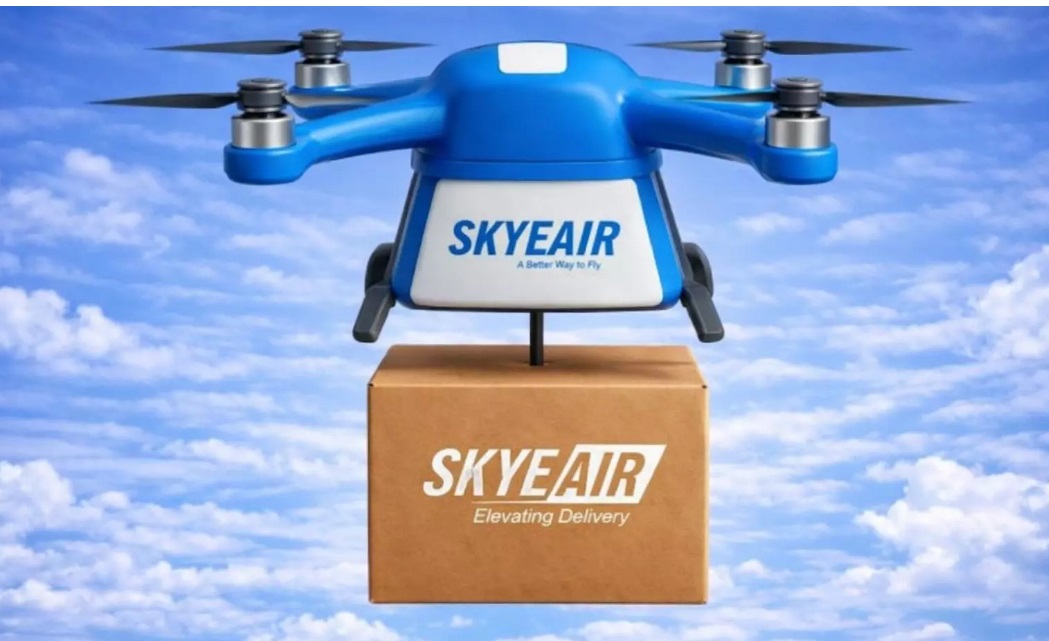
Mumbai is set to launch a futuristic drone delivery system, where residents will receive daily essentials, packages and e-commerce orders via drones. The delivery service will commence in the first quarter of 2026 in a Wadala society, marking Mumbai's first residential drone delivery initiative. Drone Firm, Developer Partner for Smart Urban Living A drone delivery company and a real estate developer have come together to acquaint with smart, sustainable urban living solutions in Mumbai. Skye Air will present the first drone delivery infrastructure in Mumbai for the residents of Wadala's Siddha Sky housing society, with its first skye-pod installation at the society. The residents will receive daily essentials, packages, and e-commerce orders via drones at a designated Skye-Pod zone set up on the premises for safe and seamless collection. According to Skye Air, each drone can cover 1km in 60 seconds, with a maximum range of 30 km, offering residents doorstep deliveries in minutes. The company has claimed to leverage its flagship drone, Skye Ship One, which can lift 10kg of shipment in one flight through coordinated drone corridors, the Skye Tunnel. The first phase of drone-enabled delivery services is scheduled to commence in the first quarter of 2026, marking Mumbai's first residential drone delivery initiative. Successful Operations in NCR, Bengaluru Skye Air claims to deliver more than 2 lakh monthly shipments in Delhi-NCR, serving 27 locations in Gurugram, two in Faridabad and one each in Ghaziabad and Bengaluru. They have partnered with delivery platforms like Bluedart, Flipkart, Shiprocket, and others, guaranteeing that residents enjoy faster, safer and greener delivery experiences right at their doorstep. The initiative will also reduce traffic congestion, minimise carbon emissions and promote sustainable logistics by taking a portion of last-mile delivery off Mumbai's crowded roads. ‘A Defining Step for Mumbai,’ Says Skye Air CEO Ankit Kumar, founder and CEO of Skye Air, said, "We are marking a defining step in shaping the future of drone-powered deliveries in Mumbai. With advanced skye-pods and AI-based route optimization via Skye UTM, we are setting a new standard for tech-enabled urban mobility, transforming the residential complex into a smart logistics node. This is more than a delivery revolution; it is the beginning of a new era in smart city infrastructure." Drone Delivery to Cut Congestion and Emissions Capt. Eshaan Khullar, vice president at Skye Air, said, "Mumbai, like most major metros, faces rising challenges from traffic congestion, delivery delays and increasing carbon emissions. With over five lakh daily last-mile deliveries across the city, traditional logistics systems are struggling to keep pace with demand. Drone-based delivery offers a futuristic, sustainable solution, making faster, safer, and contactless access to goods while significantly reducing on-road traffic and pollution.” Source : Free Press Journal

Admin 18 Nov 2025
Indigenous Kaal Bhairav Drone Wins Silver in Croatia
Drone Training Drone Flying

Indigenous Kaal Bhairav Drone Wins Silver in Croatia

India’s indigenous Kaal Bhairav drone won a silver medal at the 23rd International Exhibition of Innovations 2025 in Zagreb, Croatia. The shows that Made-in-India defence technology is now competing with some of the world’s best. India is announcing itself as a strong player in cutting-edge defence technology, armed with a fully indigenous AI-powered combat drone that can go toe-to-toe with anything Western nations produce. The Kaal Bhairav E2A2 is India's first AI-driven Medium Altitude Long Endurance autonomous combat aircraft. Built completely by the Indian defence company Flying Wedge Defence and Aerospace, this drone represents a massive breakthrough in India's military technology capabilities. This drone can fly for 30 hours straight and cover a distance of 3,000 km. Its onboard systems manage mission planning, targeting and coordinated swarm actions independently. Built For Future Warfare This drone is good because it’s extremely adaptable. Its smart onboard systems and multi-sensor setup allow it to strike from more than one direction with precision. Even if foes try to jam its signals, a common tactic that forces drones to land, it can fly and complete its mission. Its modular design makes it worthwhile in various roles, including precise attacks, electronic warfare, wide-area maritime surveillance and real-time information sharing on the battlefield. Most prominently, it provides India with a fully homegrown, affordable option compared to the costly foreign drones. India has clearly entered the global drone race with confidence. 'Made In India, For the World' After winning silver, Flying Wedge CEO Suhas Tejaskanda said, "This victory proves India's technological strength. Our goal is clear: Made in India, for the world." He stressed why this matters strategically: "India must build its own weapons and technology to end foreign dependency. Kaal Bhairav represents completely Indian design, manufacturing, and AI innovation. This strengthens Atmanirbhar Bharat." A New Defence Powerhouse Emerges The Croatia silver medal isn't just an acknowledgement; it's an authentication from the international community. Countries worldwide are reassessing India's tech capabilities. The defence export market, long controlled by the US, Russia and China, now has a formidable new competitor. India has entered the global drone market. Source: Zee News

Admin 17 Nov 2025
Indian Army, IAF To Induct 16 Laser-Based Anti-Drone Systems With 2 Km Range
Drone Training Drones In Military

Indian Army, IAF To Induct 16 Laser-Based Anti-Drone Systems With 2 Km Range

At a time when the Indian armed forces are looking to strengthen their capabilities against enemy drones, the Indian Air Force and the Indian Army are set to place orders for 16 indigenous drone detection and interdiction systems, which will be capable of targeting unmanned aerial systems at a range of 2 km with a laser and disabling them. The Defence Ministry will clear the DRDO’s Integrated Drone Detection and Interdiction System, which can hit enemy drones with laser beams at a range of 2 km. The 10-kilowatt laser beam would double the distance at which they can engage drones with a laser, as the first system was capable of targeting at around 1 km only. The DRDO is developing long-range laser-based drone detection and interception systems, as the Pakistanis used a large number of drones in the Operation Sindoor against Indian targets, which were foiled in a big way. The DRDO has also successfully test-fired the direct energy weapon system, which can target systems at a range of 5 km, and is carrying out its trials with the involvement of the Indian defence forces. A 30-kilowatt laser-based direct energy weapon will achieve the 5 km strike capability. India, for the first time this April, showcased its capability to shoot down fixed-wing aircraft, missiles, and swarm drones using a 30-kilowatt laser-based weapon system. By doing so, India joined the list of selected countries, including the US, China, and Russia, that have shown such a capability. The Centre for High Energy Systems & Sciences CHESS, a lab of DRDO, had conducted a successful field demonstration of the Land version of Vehicle-mounted Laser-directed weapon DEW MK-II(A) at Kurnool in Andhra Pradesh. It successfully defeated the fixed-wing Unmanned Aerial Vehicle and swarm drones, causing structural damage and disabling the surveillance sensors. India needs the IDDS in large numbers, as the role of drones in the recent wars, both within and outside the country, has shown a significant use of drones by enemy forces. DRDO chief Dr Samir V. Kamat had said that the DRDO is also working on other high-energy systems, including high-energy microwaves, electromagnetic pulses, and various technologies that will provide the Star Wars capability. Source: ANI

Admin 17 Nov 2025
Madhya Pradesh Looks to Become Drone Manufacturing Hub with New Policy
Drone Services Drone Training

Madhya Pradesh Looks to Become Drone Manufacturing Hub with New Policy

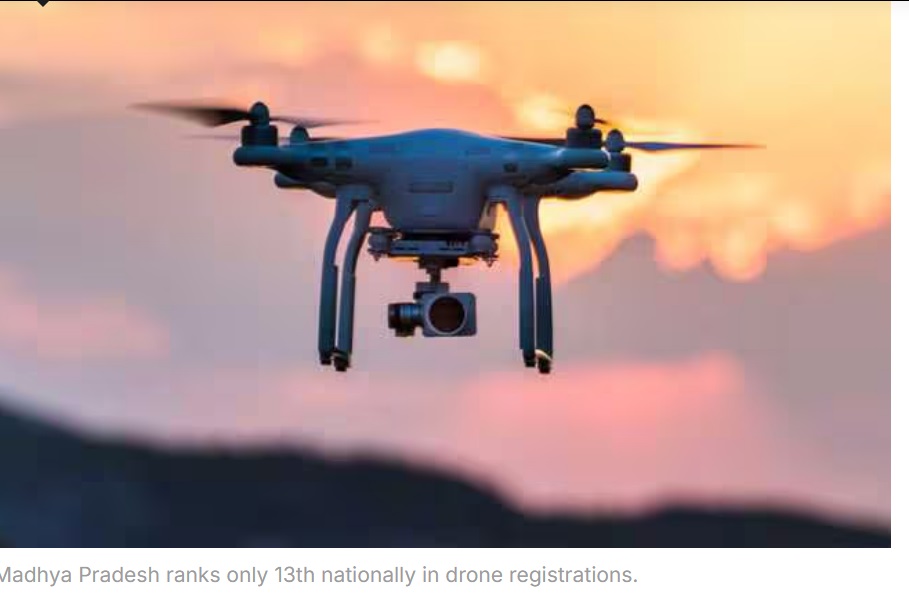
The Madhya Pradesh government has introduced the MP Drone Promotion and Utilization Policy 2025, aiming to boost drone manufacturing and its application across agriculture, logistics, security and governance. The policy offers incentives, including a 40% subsidy, up to Rs. 30 crores for new investments, and a 25% subsidy on lease rents for 3 years. Additional provisions include Rs. 2 crores in R&D grants, skill development incentives under the Seekho-Kamao Yojana, and a waiver of stamp duty and registration fees for industrial land leases. Patent filing, with the government covering Rs. 5 lakhs for domestic patents and Rs. 10 lakhs for international patents, is also supported by this policy. There can be an investment of Rs. 370 crores in the sector over the next five years in Madhya Pradesh, resulting in the creation of 8,000 jobs.  Madhya Pradesh aims to become a leader in the drone industry by harnessing drone technology to attain improved efficiency, cost reduction, and innovation. The state envisions using drones for precision agriculture, including crop monitoring and pesticide spraying, to increase productivity. Drones can augment surveying and mapping, while also reducing costs in logistics and infrastructure. Drones will also be used in surveillance, traffic monitoring, disaster management and law enforcement. With 90% of Indian airspace designated as a "Green Zone" for drone operations, the sector is poised for significant growth, contributing to financial development, job creation and improved service delivery in urban and rural areas.  Source: PIB

Saheel Singh 13 Nov 2025
Groom Stabbed at Wedding, Cameraman's Drone Chases Attackers for 2 km
Drone Training Drone Products

Groom Stabbed at Wedding, Cameraman's Drone Chases Attackers for 2 km

A wedding in Amravati turned into a crime scene on 10 th November 2025 when the groom was stabbed. A drone positioned to film the function captured the attack, but it also tracked the accused and his accomplice for almost two kilometres. The incident occurred around 9:30 p.m. at Sahil Lawn on Badnera Road, during the wedding ceremony of 22-year-old Sujal Ram Samudra. The suspect, identified as Ragho Jitendra Bakshi, approached the groom on stage and stabbed him three times with a knife, injuring him on the thigh and knee. Cameraman Follows Attacker with Drone Camera The Drone became evidence in a violent crime. The incident was captured by a drone camera, which has now become crucial evidence. As stated by eyewitnesses, as panic erupted among guests, the drone operator kept recording and even followed the attacker, capturing his movements for about two kilometres before losing sight of him. Police have since seized the footage, which shows the accused’s face and escape route. Officials have called it key evidence. The attacker, who was wearing an orange hoodie, ran off the lawn, took a bike parked outside and escaped. One more person, wearing a black outfit, joined him as they got on the bike. Both fled while one of the couple's relatives tried to catch them. The drone followed the two attackers for two kilometres, visible in the video. Altercation During DJ Performance Triggered Attack Initial investigation suggested the attack stemmed from a minor dispute during a DJ performance, where the groom and the suspect were pushed while dancing. The argument angered Bakshi, who attacked him violently. Following the stabbing, the accused also attempted to attack the groom’s father before fleeing. Following swift action, a case was registered at Badnera Police Station. SHO Sandeep Hiwale carried out the investigation. The police used the drone footage to trace the suspect and have launched a manhunt. “The accused is escaping, but with the visual evidence, his arrest is imminent,” officers said. The injured groom was admitted to RIMS Hospital, Amravati, after suffering deep wounds, but was stable. Source : India Today

Saheel Singh 13 Nov 2025
India’s First Drone Surveillance System During Elections Takes Flight in Hyderabad
Drone Pilot Drone Training

India’s First Drone Surveillance System During Elections Takes Flight in Hyderabad

At 11 a.m. on November 11, 2025, Basti Dawakhana in Hyderabad’s Borabanda area was bustling. The crowd was not there for a health check-up. Voters had assembled to cast their votes in the Jubilee Hills Assembly by-election and a drone was hovering above the heads of the people. A 33-year-old man, Deepak, controlled the drone using a mobile attached to a remote. Deepak, a licensed drone pilot from the Chennai Drone Academy, was part of a team of operators deployed across the constituency for the country’s first-ever drone surveillance initiative throughout an election. “About 40 to 45 people from the Chennai Drone Academy have come here to fly drones. Our academy was approached, and we were sent to Hyderabad,” said Mr Deepak. The live video feed from his drone camera was transmitted to the District Election Office and monitored by the Election Commission of India. Deepak explained that he was authorized to fly the drone up to 50 metres in height, in compliance with airspace restrictions near Begumpet Airport. “We have to follow all safety protocols and cannot exceed that limit,” he said. The initiative is part of a drone surveillance programme introduced by the Hyderabad District Election Office, marking a first-of-its-kind experiment in the Indian electoral process. 139 drones were deployed across 407 polling stations, each operated by a trained drone pilot from different parts of the country. “The drones offer real-time visual monitoring of sensitive locations, crowd movements and any potential violations”, said the District Election Officer and Greater Hyderabad Municipal Corporation Commissioner, R.V. Karnan. At the Natco Government High School in Borabanda, another pilot, Suresh, was operating two drones, including a DJI Mavic 4, the more advanced models used for surveillance. “This drone costs about INR 4.5 lakh and has three lenses that can zoom to a very large distance. Elsewhere, at a polling booth in Krishna Nagar, Hyderabad-based Rahul had temporarily landed his drone to recharge it. “The drone can stay in the air for about 20 minutes. Each of us carries three battery packs. When the low-battery warning appears, the drone is brought down, the battery is replaced, it is let cool for a few minutes and then it is put back in the air,”. As the byelection progressed, voters across Jubilee Hills looked up in curiosity at the whirring machines above them. Source: The Hindu

Saheel Singh 11 Nov 2025
Indian Air Force Soldiers will Train with this Aircraft, Equipped with Numerous Features
Aircraft Flying Airline Pilot

Indian Air Force Soldiers will Train with this Aircraft, Equipped with Numerous Features

The first Hindustan Turbo Trainer-40 series production aircraft, TH 4001, manufactured by Hindustan Aeronautics Limited, flew in Bengaluru on Friday. This aircraft plays a vital role in training the next generation of fighter pilots in the Indian Air Force. The IAF has signed a contract with HAL for the supply of 70 HTT-40 aircraft. The HTT-40 made its first flight in 2016 and obtained certification in 2022. What are the Special Features of the HTT-40? This is a fully acrobatic, two-seater turboprop aircraft. This aircraft was developed by HAL's Aircraft Research and Design Centre, with the needs of the Indian Armed Forces in mind. This aircraft is intended for basic flight training, acrobatics, instrument flying and night flying. It features an advanced glass cockpit, contemporary avionics and state-of-the-art safety features, as well as a zero-zero ejection seat. Maximum Speed of 450 km/h This aircraft has a maximum speed of 450 km/h. The aircraft can fly up to 6 km. The HTT-40 made its first flight on May 31, 2016 and achieved system-level certification on June 6, 2022. The Indian Air Force has signed a contract with HAL to supply 70 aircraft. Delivery of all 70 aircraft will be completed by 2020. The deal also includes a full mission simulator, which will help pilots practice several flight profiles on the ground. A Step Towards 'Atmanirbhar Bharat' The development of the aircraft is an essential step towards increasing self-reliance in India's defence and aviation industries. This aircraft has the government's vision of an 'Atmanirbhar Bharat'. Developed by HAL using indigenous technology, this aircraft will not just enhance the strength of the Indian Air Force but will also take the nation's defence production to new heights. The successful flight of the HTT-40 and the commencement of its production mark a breakthrough for the Indian defence sector. Source: India TV

Admin 07 Nov 2025
 India-Australia Sign New Deal, Will Jointly Develop Lethal Aircraft Systems
Unmanned Drones Unmanned Aircraft

India-Australia Sign New Deal, Will Jointly Develop Lethal Aircraft Systems

India and Australia have taken a substantial step to uplift defence and security cooperation to new heights. At the Army-to-Army Staff Talks held in Canberra, the two countries agreed on the joint development of unmanned aircraft systems (UAS) for naval, land, and air operations. A new strategy was also established to combat terrorism and extremism. Both countries recognized that emerging technologies and data systems are vital in defence and security. At the talks in Canberra, which ran from October 29 to 31, Indian and Australian representatives discussed next-generation drones, surveillance technology, and maritime security networks. The Indian Army stated that the two nations agreed to enhance cooperation in drone systems, allowing human-free operations even in complex and dangerous missions. Australia has expressed its desire to participate in India's Make in India Defence Initiative, allowing both countries to develop lethal drone systems utilizing indigenous technology jointly. Shared Strategy Against Terrorism and Radicalization India and Australia have joined forces not only on defence but also on the security front. The 15th Joint Working Group (JWG) meeting on counter-terrorism between the two countries concluded in Canberra. Emerging terrorist threats, online radicalization, and the use of new technologies in terrorist networks were discussed in detail. The meeting was chaired by Vinod Bahade, Joint Secretary (Counter Terrorism) of the Ministry of External Affairs of India, and Gemma Huggins, Australia's Ambassador for Counter-Terrorism. Both sides condemned the terrorist attack in Pahalgam, Jammu and Kashmir, on April 22, 2025, in which several soldiers were martyred. Australia assured India of solidarity and support. Focus: Responding to Terrorism with New Technology At the meeting, both countries agreed that terrorist organizations are now abusing new technologies such as drones, encrypted apps, and cryptocurrencies. Therefore, real-time data sharing and intelligence sharing are needed to combat this threat. The MEA statement said, "Both sides highlighted the necessity for timely information sharing and concrete steps to counter the misappropriation of new technologies for terrorist purposes." The Indo-Pacific Defence Network is Strengthening Australia and India are already part of the Quad partnership, which also comprises the USA and Japan. At the meeting, both countries reiterated their commitment to combat terrorism jointly under multilateral platforms such as the UN, FATF, GCTF, and IORA. The Indian delegation paid tribute to the fallen at the Australian War Memorial and also visited the Royal Military College, Duntroon. Source: News 18

Admin 07 Nov 2025
India's Drone Warfare Roar Leaves Pakistan Sweating, Army Launches Powerful Attack in 'Vayu Samanvay II
Drone Piloting Drone Training

India's Drone Warfare Roar Leaves Pakistan Sweating, Army Launches Powerful Attack in 'Vayu Samanvay II

The Indian Army completed the 'Vayu Samanvay II' exercise in the desert terrain. During the exercise, the Southern Command conducted drills in drone and anti-drone warfare. The exercise aimed to address future emerging aerial threats and further strengthen capabilities and response efficiency. The exercise was conducted in the desert region bordering Pakistan. Through this drill, the Army sent a clear message to neighbouring countries China and Pakistan: It is fully prepared to respond to any suspicious activity along the border. Real-Time Battlefield-Like Environment The Ministry of Defence stated that the drill was conducted in realistic war-like conditions. It comprised an electronic warfare environment and a multi-domain operation setup. Coordination among ground and air resources was established through command-and-control centres. Response tactics were then tested. Its objective was to prepare the Army for the next-gen battlefield and evaluate its capabilities. Drone vs. Drone Technology Confrontation The two-day exercise tested the fundamentals of drone and counter-drone operations. Held near India's border with the desert, the exercise examined emerging aerial threats and tested the effectiveness of surveillance, jamming and response systems. Indigenous Technology and Joint Operations Air Coordination-II also established coordination among several branches of the Indian Army. Indigenous technologies and systems were tested in field-level operations. This exercise is a crucial step in further refining tech-enabled operations in border areas. Army Statement Lieutenant General Dheeraj Seth, GOC-in-Chief of Southern Command, praised the success of the exercise. He said that it will significantly help the Indian Army in rapidly integrating drone and counter-drone systems. This demonstrates the Indian Army's readiness to adopt modern technology in a multi-domain battlefield. He said the Army is continuously working on defence modernization and innovation to meet emerging threats on every front. The Indian Army is building a tech-driven and combat-ready force for future warfare. Source : Zee Hindustan

Admin 07 Nov 2025
India Turns Battlefield Into a ‘Drone Factory’ With New Mobile Fabrication Units
Drone Products Drone Training

India Turns Battlefield Into a ‘Drone Factory’ With New Mobile Fabrication Units

India is taking drone warfare to the next level with mobile drone factories that can print, build and launch drones wherever the mission demands. The initiative comes from Zuppa and Divide By Zero Technologies (DBZ), teamed up to create containerized fabrication units capable of producing drones on the spot. These compact, deployable drone labs slash drone production time from weeks to just hours. By moving manufacturing to the field, the idea also aims to decrease reliance on central amenities and lengthy logistics, improving response speed throughout both combat and disaster operations. “This collaboration is a major step in the direction of Atmanirbhar Bharat in frontline technology,” said Venkatesh Sai, Zuppa co-founder and technical director. “By allowing rapid, on-demand drone manufacturing right at the field, we are giving defence forces unparalleled autonomy and adaptability.” Factory on the Frontline The Rapid Fabrication Container Unit merges DBZ’s industrial-grade 3D printing expertise with Zuppa’s AI-enabled drone systems and mission software. Together, they form a moveable production hub that can function in isolated or risky areas. The setup supports three core tasks: field-based drone creation for tactical, surveillance and logistics roles, repair or modification of present drones, and instantaneous deployment through Zuppa’s autonomous flight network. “Our partnership with Zuppa alters mobile, autonomous manufacturing into reality, bringing production competence directly to the battlefield,” added Swapnil Sansare, founder and CEO of DBZ. Source: The Defense Post

Admin 07 Nov 2025
India Awards USD 32.5M to Zen Technologies for Advanced Anti-Drone Upgrades
Drone Training Drone Products

India Awards USD 32.5M to Zen Technologies for Advanced Anti-Drone Upgrades

India has awarded 2.89 billion rupees in contracts to Zen Technologies to upgrade its anti-drone systems. The company will complete the upgrades within a year, integrating lessons learned from recent frontline operations such as Operation Sindoor, a May counterterrorism offensive by India in Jammu and Kashmir. The contracts enhance both hardware and software adaptability, a capability that foreign systems frequently cannot offer due to export controls and vendor limitations. The advancements target two critical vulnerabilities: physical hardware compromise and software-level malware attacks, the kind seen in the Stuxnet operation that halted Iran’s nuclear program and in the 2024 pager attacks that killed and wounded hundreds of Hezbollah fighters in Lebanon. Zen Managing Director and Chairman Ashok Atluri said that the company is keeping India one step ahead in the face of rising threats. “Buying Indian-designed, developed and manufactured products is not an option, it’s a prerequisite for survival as drone and cyber threats keep evolving,” he said. Other Anti-Drone Systems Development in India India is actively deploying a range of indigenous counter-drone solutions to protect against emerging challenges. India’s DRDO, in collaboration with BHEL has developed the D4 system, which integrates radar, RF sensors, electro-optical/infrared cameras, jammers and laser-based directed energy weapons. It provides both mobile and static configurations and is intended for rapid induction across the armed forces. Adani Defence & Aerospace and DRDO revealed a vehicle-mounted counter-drone system in February 2025 that combines radar, SIGINT/EO sensors, jammers, a 7.62-mm gun, and a high-energy laser. Intended for mobility, it can protect critical areas at ranges of up to 10 kilometres in varied terrain. Private companies, such as Solar Defence and Aerospace Limited, are developing systems like the Bhargavastra micro-missile anti-drone system, designed to intercept loitering munitions and autonomous drone swarms. These systems validate India’s mounting capability to address sophisticated drone threats beyond commercial drones. Source: The Defense Post

Admin 07 Nov 2025
IIT Bombay Researchers Develop GPS-Free Control Scheme for Autonomous Drone Swarms
Drone Technology Drone Training

IIT Bombay Researchers Develop GPS-Free Control Scheme for Autonomous Drone Swarms

A new control scheme developed by Dwaipayan Mukherjee and Chinmay Garanayak at IIT Bombay enables drones to fly in coordinated swarms without relying on GPS, inter-drone communication, or centralized control systems. The method uses bearing-only measurements obtained through onboard cameras to regulate relative positions and maintain formation. The researchers applied the scheme to Vertical Take-Off and Landing UAVs, which can lift off without a runway and hover mid-air. These drones are appropriate for surveillance and monitoring. “Autonomy in a swarm is an important task,” Mr Mukherjee said. “This means that vehicles in a swarm can decide their ‘actions’ on the basis of variables they can measure with their on-board sensors, rather than having to rely on some global information being fed to them or some human/centralized computer deciding what their action ought to be. This is where our paradigm differs from usual ones,” he added. The planned ‘bearing-only’ control scheme lets each drone use its onboard camera to observe its immediate neighbours and calculate bearing information. “In bearing-only control, the goal is to attain formation control using only interagent bearing measurements,” Mr. Garanayak said. The system does not need GPS or communication with other drones or a central computer. A new control scheme advanced by Professor Dwaipayan Mukherjee and research scholar Chinmay Garanayak at IIT Bombay allows drones to fly in coordinated swarms without relying on GPS, inter-drone communication, or centralised control systems. The method uses bearing-only measurements obtained through onboard cameras to regulate relative positions and uphold formation. The researchers applied the scheme to VTOL UAVs, which can lift off without a runway and hover mid-air. These drones are suitable for operations in confined spaces, such as surveillance and monitoring. “Autonomy in a swarm is an important task,” Mr. Mukherjee said. “This means that vehicles in a swarm can decide their ‘actions’ based on variables they can measure with their on-board sensors, instead of having to rely on some global information being fed to them or some human/centralized computer deciding what their action ought to be. This is where our paradigm differs from usual ones,” he added. The proposed ‘bearing-only’ control scheme allows each drone to use its onboard camera to observe its immediate neighbours and calculate bearing information. “In bearing-only control, the goal is to achieve formation control using only interagent bearing measurements,” Mr. Garanayak said. The system does not require GPS or communication with other drones or a central computer. Camera-based measurements are less prone to noise than conventional distance sensors, simplifying the drone’s sensor system and reducing battery requirements and overall weight. The scheme is designed to operate in areas where GPS is unavailable, making it suitable for stealth-mode operations, such as covert military missions. VTOL drones are underactuated systems that have six degrees of freedom, but fewer directly controllable degrees of freedom. While they can move vertically and rotate around three axes, lateral and forward-backwards movements must be indirectly controlled. “Many of the results in the literature do not address the underactuated dynamics of VTOL vehicles and only focus on the kinematic model. This motivated us to consider the fully underactuated model of the VTOL UAV and explore its applicability to formation control,” Mr. Mukherjee said. Underactuated systems require dynamic models that include position, orientation, velocities, forces, torques, and inertia. Previous attempts to apply bearing-only control to such models have often failed due to instability or breakdowns under certain conditions. Mr Mukherjee and Mr Garanayak proposed a control mechanism that ensures convergence and maintains the desired formation, even when drones start from imperfect positions. They have offered rigorous mathematical proof to support the reliability of the system.  A new control scheme developed by Dwaipayan Mukherjee and Chinmay Garanayak at IIT Bombay allows drones to fly in coordinated swarms without relying on GPS, inter-drone communication or centralized control systems. The method makes use of bearing-only measurements obtained through onboard cameras to determine relative positions and uphold formation. The researchers applied the scheme to VTOL drones, which can lift off without a runway and hover mid-air. These drones are suitable for operations in confined spaces, such as surveillance and monitoring. “Autonomy in a swarm is a critical task,” Mr. Mukherjee said. “This means that vehicles in a swarm should be able to decide their ‘actions’ based on variables they can measure with their on-board sensors, instead of having to rely on some global information being fed to them or some human/centralized computer deciding what their action ought to be. This is where our paradigm differs from usual ones,” he added. The proposed ‘bearing-only’ control scheme allows each drone to use its onboard camera to observe its immediate neighbours and calculate bearing information. “In bearing-only control, the goal is to achieve formation control using only interagent bearing measurements,” Mr. Garanayak said. The system does not require GPS or communication with other drones or a central computer. Camera-based measurements are less prone to noise than conventional distance sensors, simplifying the drone’s sensor system and reducing battery needs and overall weight. The scheme is designed to operate in areas where GPS is unavailable or communication may be jammed, making it suitable for stealth-mode operations, such as covert military missions. VTOL drones are underactuated systems, which means they have six degrees of freedom but fewer directly controllable degrees of freedom. While they can move vertically and rotate around three axes, lateral and forward-backwards movements must be indirectly controlled. “Many of the results in the literature do not address the underactuated dynamics of VTOL vehicles and only focus on the kinematic model. This motivated us to consider the fully underactuated model of the VTOL UAV and explore its applicability to formation control,” Mr. Mukherjee said. Underactuated systems require dynamic models that include position, orientation, velocities, forces, torques, and inertia. Previous attempts to apply bearing-only control to such models often fail due to instability or breakdowns in certain conditions. Mr. Mukherjee and Mr. Garanayak developed a control mechanism that ensures convergence and maintenance of the desired formation, even when drones start from imperfect positions. They have provided rigorous mathematical proof to support the reliability of the system.  Their work addresses two operational scenarios. In the first, drones maintain formation at constant velocity using bearing and bearing-rate data. In the second, where formation and velocity vary over time, drones incorporate their own velocity measurements in addition to bearing data. The system can handle arbitrary time-varying configurations, allowing drones to navigate narrow passages, reconfigure into single-line formations, and adapt to changing mission requirements.  The researchers plan to test the control scheme experimentally, using a drone swarm. On the future roadmap, they aim to address collision avoidance with theoretical guarantees. “Most existing algorithms rely on  ad hoc  collision avoidance schemes that do not come with any theoretical guarantees. Collision avoidance with objects in the environment and among drones is a challenge we are trying to tackle at a theoretical level,” Mr Mukherjee said.  Source: The Hindu

Admin 07 Nov 2025
NASSCOM Opposes New Drone Bill, Calls for Stronger Enforcement Under Existing Rules
Drone Rules Drone Pilot

NASSCOM Opposes New Drone Bill, Calls for Stronger Enforcement Under Existing Rules

The National Association of Software and Service Companies has questioned the requirement in the government’s proposed Civil Drone Bill, 2025, saying it could undo the liberalization achieved under the present regulatory framework. What the Draft Civil Drone Bill Proposes The Civil Aviation Ministry released the draft Bill in September, seeking to start a statutory framework for drones. The Bill will replace the Drone Rules, 2021 and sets out provisions for: Registration and Type Certification of all Drones, with no exemptions for small or hobby models. Compulsory safety and security features to be agreed upon by the government. Obligatory third-party insurance for all drone operators. Criminal consequences for violations, along with imprisonment of up to three years in some cases. Authority for law implementation to detain drones and related apparatus for up to seven days if a violation is suspected. The bill also establishes a compensation mechanism for drone-related accidents Why NASSCOM says a New Law isn’t Needed? NASSCOM’s central argument is that there is “no clear justification” for a complete legislative overhaul. The industry body said the Drone Rules, 2021, together with the Bharatiya Vayuyan Adhiniyam, 2024, already provide a comprehensive framework for safety, accountability and oversight. Instead of introducing a new statute, NASSCOM argued, the government should focus on better enforcement of existing rules. What the Draft Civil Drone Bill proposes The Ministry of Civil Aviation released the draft Bill in September, seeking to create a statutory framework for drones. The Bill will replace the Drone Rules, 2021, and sets out provisions for: Drone Registration, with no exemptions for small drones. Mandatory safety and security features to be arranged by the government. Compulsory third-party insurance for all drone operators. Criminal penalties are levied for violations, including imprisonment of up to three years in some cases. Authority for law implementation to detain drones and related equipment for up to 7 days if a violation is suspected. The bill also introduces a compensation mechanism for drone accidents Why NASSCOM says a New Law isn’t Needed NASSCOM’s central argument is that there is “no clear justification” for a comprehensive legislative overhaul. The industry body said the Drone Rules, 2021, together with the Bharatiya Vayuyan Adhiniyam, 2024, already provide a comprehensive framework for safety, accountability, and oversight. Instead of introducing a new statute, NASSCOM argued, the government should emphasize better implementation of current rules. Exemptions for Educational Projects, Hobbyists Removed : The Drone Bill eliminates earlier exemptions for nano drones, hobbyist models and educational projects, compelling students and researchers to get certification and registration. Criminalization of Minor Offences : The bill recommends imprisonment and criminal liability for procedural violations that may not include safety risks. Lack of Focus on Innovation : The bill lacks provisions to support R&D, domestic manufacturing or export incentives. NASSCOM warned that these provisions could create uncertainty and discourage startups from entering the drone sector. What are the Recommendations of the Industry Body? Instead of scrapping the Drone Rules, 2021, NASSCOM has suggested targeted amendments to strengthen enforcement and compliance mechanisms. Its proposals include introducing a graded penalty framework that distinguishes between civil and criminal offences; establishing a drone claims tribunal to handle accident-related disputes; allowing the digital levy and the payment of penalties through online systems, and so on. Why This Matters? India’s drone industry will reach $USD 4.9 billion by the end of this decade, growing at a 44% CAGR. NASSCOM argued that the sector's growth depends on regulatory certainty and ease of doing business. The Ministry of Civil Aviation is yet to announce a timeline for finalizing the Bill.

Saheel Singh 07 Nov 2025
87 MALE Drones will Wreak Havoc; the Defence Ministry's 30,000 Crore Plan
Drone Training Drone Flying

87 MALE Drones will Wreak Havoc; the Defence Ministry's 30,000 Crore Plan

87 MALE Drones will Wreak Havoc; the Defence Ministry's 30,000 Crore Plan The Indian Army, positioned around the clock to make India's borders impregnable, will receive a major boost in its strength. This will not only suit modern warfare conditions but also modernize the army's entire fleet. The Indian Defence Ministry is preparing to launch a major revolution in the country's drone manufacturing sector. The Medium Altitude Long Endurance (MALE) drone program has now entered an important phase, aiming to improve instantaneous surveillance and intelligence along the land and maritime borders with China and Pakistan. The Defence Acquisition Council has accepted the acquisition of 87 indigenous MALE drones, which will cost about INR 30,000 crore. How Will the Purchase be Conducted? The most significant aspect of this major procurement is that the contract will be divided between two competing Indian firms in a 64:36 ratio. This essentially means that two separate and independent manufacturing units for MALE drones will be established in India, increasing production speed and enabling faster fulfilment of future orders. The armed forces will soon seek expressions of interest from Indian companies, following which extensive testing will be conducted. What is the Ministry of Defence's Plan? The Ministry of Defence has issued specific guidelines for this ambitious project, emphasizing the importance of indigenization. The total order, worth over ₹30,000 crore, will be divided between the two lowest bidders. The prime contractor will receive 64 per cent, and the other 36 per cent. As such, the selected companies will be required to manufacture the airframe and primary components locally. The engines will also be assembled and tested in India. At least 60 percent of the content must be indigenous. What is the Speciality of MALE Drones? These drones will act as a force multiplier for the Indian Army, Air Force, and Navy, significantly enhancing India's combat capability. These MALE drones will be capable of performing a variety of tasks, including intelligence (ISR), surveillance, reconnaissance missions, electronic warfare, and precision strike. Furthermore, these drones will be designed to fly for over 30 hours at altitudes exceeding 35,000 feet, enabling them to conduct continuous surveillance over long distances. India has previously procured MALE drones from foreign suppliers, such as Israel. The feat of this indigenous program will reduce foreign dependence. Source: Zee News

Saheel Singh 05 Nov 2025
800 Swarm Drone Systems are in the Pipeline, IAF is Preparing for Major Deployments
Drone Flying Drone Training

800 Swarm Drone Systems are in the Pipeline, IAF is Preparing for Major Deployments

The Indian Air Force (IAF) is planning to acquire 800 Medium Range Swarm Unmanned Munition Systems (SUMS). According to a report, these swarm drones can target enemy positions at ranges of over 350 kilometres with pinpoint accuracy. These drones, equipped with loitering munitions, locate enemy positions, identify them and then attack them with pinpoint accuracy, destroying them. This System can Deploy 20 Drones at a Time According to a Tribune India report, each Medium Range Swarm Unmanned Munition System (SUMS) can deploy a swarm of at least 20 drones in sequence. They can hover for at least half an hour over a designated area of ​​over 350 kilometres, identify targets and then launch a full-scale attack. They can identify both stationary and moving targets. These Swarm Drones are Extremely Lethal According to a Request for Proposals received by the Ministry of Defence on October 25, these drones will jam enemy air defence systems, evade radar and enable the Indian Air Force to target enemy command-and-control systems within a few hours. The Air Force requires fixed-wing drones that can run on both jet engines and batteries. These drones can carry weapons weighing up to 30 kg. They will also be equipped with essential sensors, electronic jammers, communication systems, and navigation equipment.   They Can Fly in Temperatures Ranging from -20°C to 50°C These drones will operate effectively at altitudes ranging from sea level to 16,000 feet. They can be launched and recovered from rough roads and ship decks. These drones will operate reliably over a temperature range of -20°C to 50°C. The Rising of Drones in Modern Warfare Drones have transformed battlefields in the modern era. They are used for attacks, surveillance and even for cargo transportation. Following their success in Operation Sindoor and ongoing conflicts with other countries, drones have been adopted by every branch of the Indian Army. They are seen as cost-effective and a tool that reduces risk for soldiers. Source : Navbharat Times

Saheel Singh 29 Oct 2025
You will be on the Radar as soon as the Drone is Flown, and the Portal will have Data on Every Purchase, an Order from the Yogi Government
Drone Pilot Drone Flying

You will be on the Radar as soon as the Drone is Flown, and the Portal will have Data on Every Purchase, an Order from the Yogi Government

Flying a drone without permission will no longer be easy. You'll be on radar as soon as you fly it. The UP government has taken a major step in the realm of security. Under this initiative, the seller is required to provide complete information on the portal, from the drone's purchase to its intended use. As a pilot project, this system has been implemented in 10 police Commissionerate districts, including Gorakhpur, Ayodhya and Mathura. Later, it will be implemented across the state. The online portal "Unified Drone Application and Authorization Network (UP UDAN), developed under the state's "Drone Operations Security Policy-2023," is now officially live. The portal is available at https://udaan.up.gov.in and will operate under the operational support period until August 4, 2026. Through this, all processes related to drone operations, permits, sales and monitoring will be recorded and controlled online on a single platform. Flying drones without registration has been prohibited. Security Headquarters, Lucknow, has directed the Police Commissioners of the state's Police Commissionerate districts and the Senior Superintendents of Police of Gorakhpur, Ayodhya, and Mathura to conduct a registration drive for drone operators and sellers in their respective districts and submit action reports to Headquarters. A "Drone Register" should be maintained in each district, and all drone information should be recorded on the "UP UDAN" portal. Officials say this system will not only strengthen security and surveillance, but it will also play a vital role in surveys, traffic monitoring, and disaster relief operations. Immediate Action will be taken on Illegal or Suspicious Flights. Omninet Technology Private Limited has developed this portal. According to the platform, it will make drone operations transparent and accountable. A digital record will be maintained for every registered drone, and security agencies will be able to take immediate action on any illegal or suspicious flight. Districts Included in the Pilot Project Under the pilot project, the following districts have been included in this system: Gorakhpur, Lucknow, Ayodhya, Mathura, Kanpur, Prayagraj, Varanasi, Agra, Gautam Buddha Nagar, and Ghaziabad. Later, there are plans to implement it across the state. What Did the Police Say? City SP Abhinav Tyagi said that all police station in-charges have been instructed to register drones compulsorily. So far, 171 drones have been registered in Gorakhpur, and registration for the remaining is ongoing. The government has issued guidelines regarding where and at what altitude registered drones should be flown. Legal action will be taken against those who fly drones in violation of these instructions. Source: Hindustan

Saheel Singh 27 Oct 2025
How to Fly a Drone? Haryana Corp is set to Train the Youth
Drone Training DGCA Approved Drone Training Institute

How to Fly a Drone? Haryana Corp is set to Train the Youth

The Haryana Scheduled Castes Finance and Development Corporation has launched a drone pilot training programme in the city, aiming to provide more employment opportunities in the burgeoning drone technology sector. In the first batch, 26 youngsters will receive drone training. The programme meets the requirements of youth from the scheduled castes, offering them a prospect to gain proficiency in a field experiencing exponential growth. India’s First Drone Warfare School Set Up by BSF to Tackle Evolving Border Threats As per the eligibility criteria, the candidate must belong to the SC category of Haryana, be between the ages of 15 and 45, have an annual family income of not more than Rs 3 lakh, and have passed the 10th standard. Earlier, the government also ran a Drone Didi programme under which women were given specialized training as drone operators. Gurgaon deputy commissioner, Ajay Kumar, said that the application process is entirely offline, and interested candidates can submit their applications in person at the HSFDC office located at house number 62-63, Sanjay Colony, Sector 12 in Gurgaon. The initiative is part of a broader strategy to uplift youth from marginalized communities by providing them with the skills necessary to thrive in modern industries and aims to offer participants a chance of securing employment in industries like agriculture, logistics, surveillance and more. "This initiative is a step in the direction of inclusivity and empowerment. By providing specialized training in drone technology, we are not only enhancing the skill set of our youth but also ensuring that they are well-prepared to seize emerging opportunities in the job market," said DC Kumar. The training will cover various aspects of drone operation, including safety protocols, navigation, maintenance, and regulatory compliance. Participants will gain practical experience with the latest drone, ensuring they are industry-ready upon programme completion. Source : Times of India

Saheel Singh 27 Oct 2025
Delhi's Drone Didi’s Take Flight: The Police's State-of-the-art Initiative to Keep a Close Eye on Delhi
Drone Pilot Drone Training

Delhi's Drone Didi’s Take Flight: The Police's State-of-the-art Initiative to Keep a Close Eye on Delhi

The West District of Delhi Police has launched an initiative called "Netra-Netra-Nari," an important step toward both modern policing and women's empowerment within the police force. In this project, female constables will be positioned to operate cutting-edge surveillance drones in tremendously crowded market areas throughout the vital festive season. These Drone Didis are now an important part of instantaneous security operations in busy areas like Rajouri Garden, Moti Nagar, Tilak Nagar and Kirti Nagar. Their main role of the same is to influence drone technology for inclusive aerial surveillance, providing irreplaceable understandings that ground teams cannot achieve. Exactly, they are tasked with monitoring the movements of large crowds, detecting suspicious activities, controlling traffic congestion from above and identifying any unfortunate incidents. The main strength of this initiative lies in its competence: video captured by pioneering drones is sent directly to the district's control rooms. This instantaneous data flow lets field units respond quickly and coordinate professionally, reducing response time to potential security breaches or violations of law and order. As senior police officials stated, this move advances overall policing efficiency by leveraging modern knowledge and also reflects the growing role of women in tech-driven security and leadership positions. The observers state that by putting women in command of erudite surveillance systems, the Delhi Police is not only strengthening security in jam-packed public spaces but also setting an example for gender inclusion in policing across the nation. Source : News 18

Saheel Singh 24 Oct 2025
half-star-solid phone